(Ed. note: Middletown Point was an early name for the village later renamed “Matawan” in 1857. “Mount Pleasant” was a separate rural community at the southern end of Middletown Point, in the area adjoining present-day Route 79. The Freneau family homestead was located here, and the community was renamed “Freneau” in 1889 in honor of the poet. In his publications, Freneau described Mount Pleasant as being “near Middletown Point,” and while the two areas kept separate identities, they also shared many common interests. For the purposes of this article, “Middletown Point citizens” refers to residents of both areas unless otherwise noted.)
By 1794, Philip Freneau had left Philadelphia and the partisan National Gazette project and returned to his farm at Mount Pleasant. He built a printing press at his home and occupied most of his time printing and farming. One of his first publications here was The Monmouth Almanac, a kind of early local Farmers Almanac, which included weather forecasts, astrological lore, tide tables, and didactic articles of general interest. The almanac never attracted enough subscribers and soon failed.
In 1795, Freneau edited and reprinted many of his previously written poems in a volume titled Poems Written Between 1768 and 1794 – an original copy of which is on display in the Burrowes Mansion Museum. The book was a “modest success,” but was far from lucrative for Freneau.
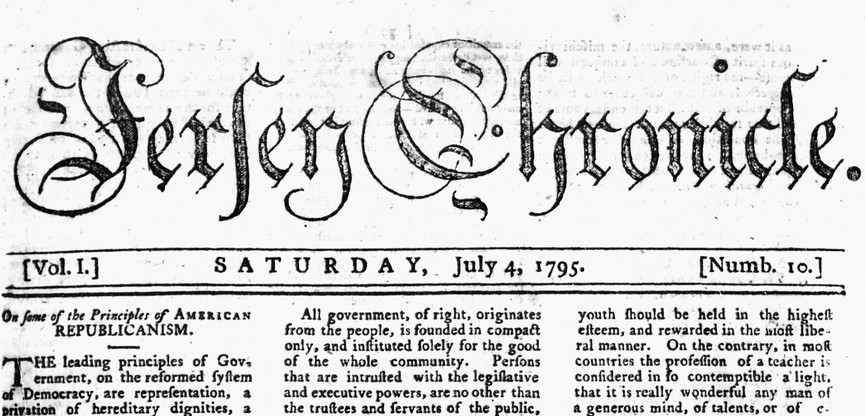 That same year, Freneau launched the Jersey Chronicle, a politically oriented weekly now regarded as the first newspaper printed in Monmouth County. The paper was important for its role in capturing a picture of the local political scene in a critical year in American history. Lewis Leary, in That Rascal Freneau, wrote:
“Never was there a more interesting period than the present,” Freneau told his readers in the first issue of the Jersey Chronicle. Nor, he said, had mankind ever been so united in “emancipating themselves from those shackles of despotism which . . . so long impeded the happiness of the human species, and rendered the rights of the many subservient to the interests of the few.” New republics were forming, new empires bursting into birth, and the family of mankind was advancing from the shadow of tyranny to the sunlight of democracy. At such a time the editor was proud “to renew his efforts for contributing, in some small degree, to the general information of his fellow citizens in the present history, and politics of the world.”
1795 was a year of great tension between the United States and Great Britain, and there was fear of renewed war between the countries. Although the Treaty of Paris had ended the American Revolution in 1783, it left several disputes unsettled – among them the repayment of pre-war debts and compensation for Loyalists.
The growing conflict with Britain also divided American politics. Alexander Hamilton and the Federalists wanted to preserve peace and trade with Britain, America’s largest trading partner, since customs duties on British goods funded much of the federal government. Thomas Jefferson and the emerging Democratic-Republicans were more sympathetic to Revolutionary France and suspicious of British influence.
Philip Freneau and many of the citizens of Middletown Point fell into the latter camp. Freneau had worked for Jefferson, and the principles of Jeffersonian democracy were close to his own. He had a natural affinity for France and idealized French democracy. He was a critic of the Federalists and of George Washington’s foreign policy. But most of all, Freneau despised the British – a feeling that was greatly amplified after his incarceration in a British prison ship in 1780. One imagines the citizens of Middletown Point shared these strong anti-British sentiments. The town had been ravaged by raids during the war, and men who had once fought the British in the local Militia now held positions of local influence.
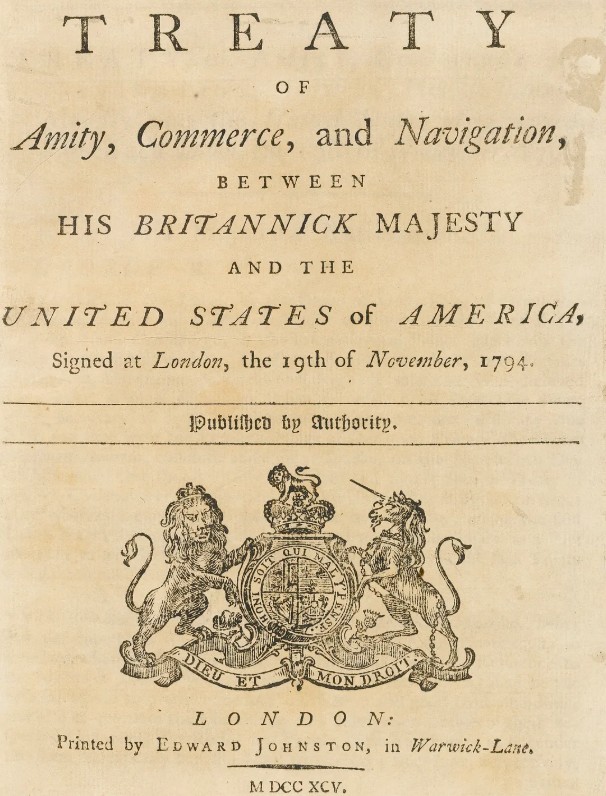 A solution to the conflict between Britain and America was proposed in the Jay Treaty, which was signed on November 19, 1794, and ratified by the U.S. Senate in 1795. It was negotiated by Chief Justice John Jay, whom Washington sent to London to resolve the disputes with Britain. The Treaty was extremely controversial in Middletown Point, as well as most of the country. Critics, especially Jeffersonians, saw it as too favorable to Britain and a betrayal of France, America’s Revolutionary War ally – a violation of the principles we fought for in the Revolution. Supporters pointed to the trade and economic boost it gave to the United States.
Washington did not sign the Jay Treaty until August 14, 1795. In late June, details of the Treaty were leaked to the public, causing a national political upheaval, including mass meetings and protests.
Freneau’s Jersey Chronicle was full of anti-Jay Treaty letters and articles, although many of them were not written by Freneau himself. The flurry of opposition continued even after Washington’s ratification in August. The paper became a forum for anti-Treaty, anti-Federalist, and anti-British views.
Locally, a great anti-Treaty fervor arose in the population, and committees were formed to oppose the Treaty. Citizens like Asher Holmes and Thomas Hunn organized local meetings and coordinated petition campaigns. The Chronicle posted notices like the following:
TOWN MEETING.
Agreeably to notice given in the Jersey Chronicle of Saturday last, a large number of persons, inhabitants of the townships of Middletown and Freehold, met on Wednesday the 19th inst. at the house of Major Thomas Hunn, in Mount-Pleasant, to offer their sentiments on the pending Treaty between America and Great Britain, in conformity to the constitutional right of the people to assemble together, and freely express their opinions, in a peaceable manner, on the proceedings of Government.
Col. ASHER HOLMES was then unanimously appointed Chairman, & P. FRENEAU Secretary.
At the unanimous request of the persons present, the Treaty was then read, discussed article by article as far as time would allow, and the reasons of dissent given on a number of the articles.
On motion, a committee of five persons was appointed, to draw up a number of Resolutions, assigning the particular reasons upon which the committee do ground their general disapprobation of said Treaty; for the purpose of hearing and deciding on which Resolutions, and to express their full and unbiassed opinion of the Treaty, the company now attending did further agree to meet again at the house of major Hunn, on Wednesday the 26th inst. at 1 P. M.
(Jersey Chronicle, August 22, 1795, p. 146)
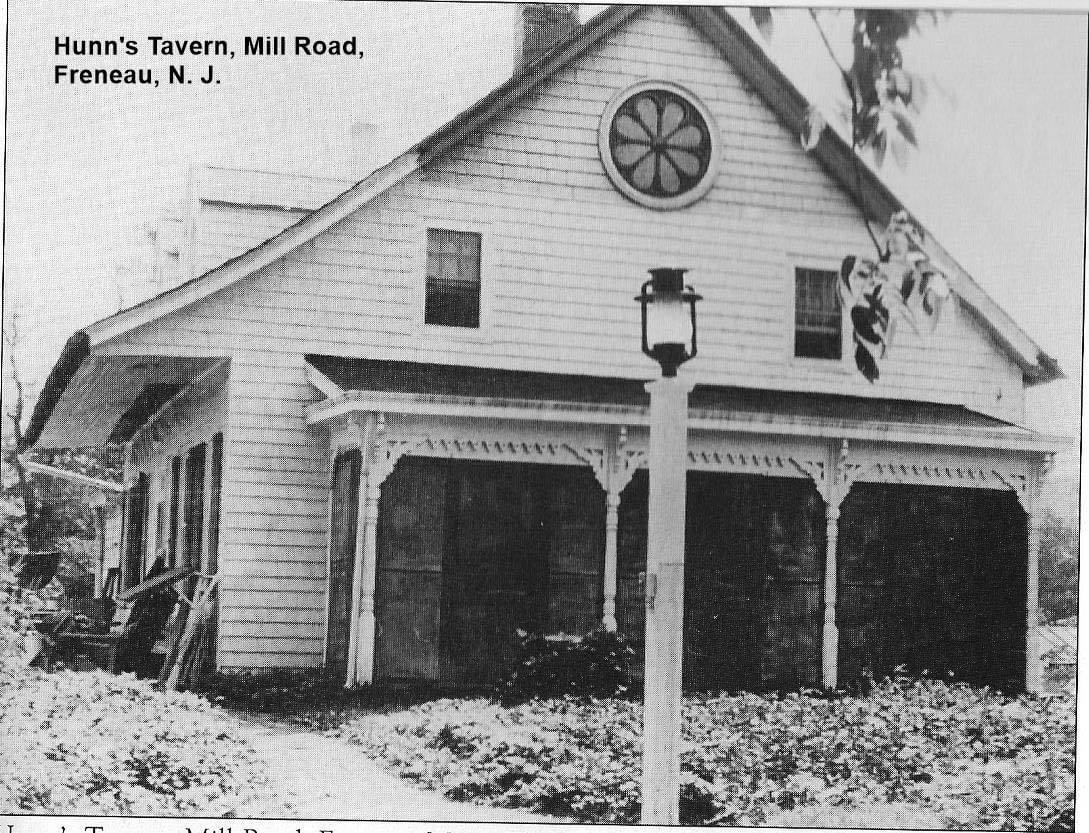 Leary notes that Freneau “was apparently a solid citizen to whose views the local leaders who met at Major Thomas Hunn’s tavern, just off the main highway at Mount Pleasant, listened with respect.” (The home that was Hunn’s tavern still stands today – it is the oldest house in Matawan.) At this moment, Freneau’s standing in the local community may have reached its peak.
Celebrating Independence Day in a Year of Disaffection
Many Fourth of July celebrations across the country turned into organized occasions for condemning the Jay Treaty.
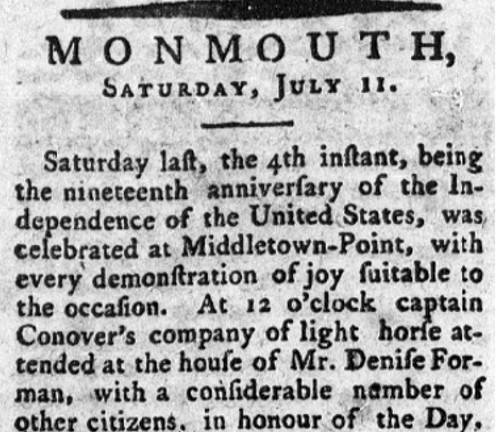
This was particularly evident in Middletown Point and Mount Pleasant, where each community held its own celebration. (Separate celebrations reinforce the notion that each locale maintained its own identity but also hinted at possible political differences among the organizers.) The July 11th issue of the Chronicle reported on both events, as shown below.
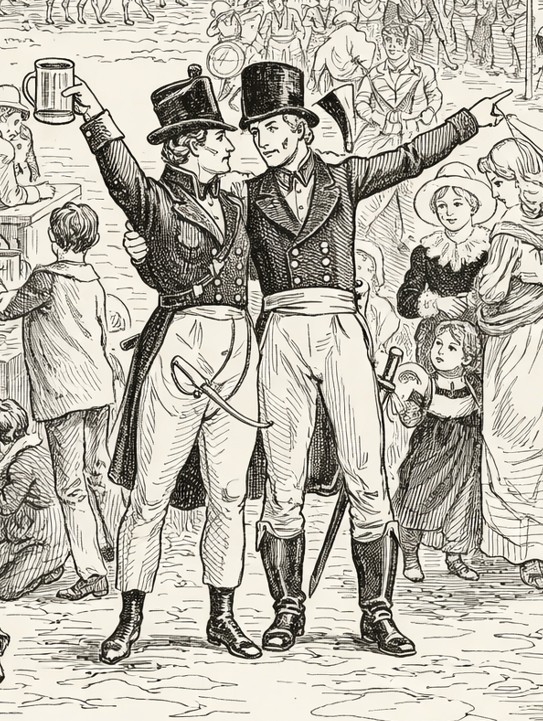 The first, held at the home of Mr. Denise Forman, was said to bring “every demonstration of joy suitable to the occasion.” The afternoon included artillery salutes, an oration, a hymn with lyrics composed by Freneau, and a series of toasts followed by a public dinner. (Toasts were part of the standard ritual for celebrating this holiday in early America; see an example of a Freneau toast list here.)
Here is the Chronicle account:
Saturday last, the 4th instant, being the nineteenth anniversary of the Independence of the United States, was celebrated at Middletown-Point, with every demonstration of joy suitable to the occasion. At 12 o’clock captain Conover’s company of light horse attended at the house of Mr. Denise Forman, with a considerable number of other citizens, in honour of the Day, when after one discharge from a field piece, an animated Oration was delivered, by the Rev. William Hobrow, succeeded by a Hymn to Liberty (for which see our last page.) Fifteen rounds of Artillery were then discharged, after which a large company sat down to an elegant dinner, during which the following Toasts were drank——Peter Schenck, Esqr. in the chair.
-
- THE DAY: And may the occasion of it never be forgotten.
- The President of the United States—Three Cheers.
- General Wayne, and our brave fellow citizen soldiers in his army.—Three Cheers.
- The Rights of Man; and may they speedily be recognized throughout the world.
- Governor Howel, and the citizens of New-Jersey.
- The Republic of France; and may all Despots meet the fate of Louis the sixteenth.—Amen! 3 cheers.
- The genuine American, who never blushed at the plough, nor trembled at the sword. Three Cheers.
- The majesty of the people.—three cheers.
- The Republican Interest throughout the world.
- A speedy cure for the kings’ evil.—3 cheers.
- May no power exist but what is derived from the People, and exercised for their benefit.
- The Rising Generation.
- The American Fair.—5 cheers.
- The Liberty of the Press throughout the world. 3 cheers.
- May the ties that unite America and France never be broken.—5 cheers.
- May the oppressed of all nations find an asylum in the United States of America.
The festive scene was conducted with the utmost decorum, and the company broke up at an early hour, and returned to their respective homes.
(Jersey Chronicle, Saturday, July 11, 1795, p. 93)
The alignment with France and antipathy toward Britain are evident in the toasts, as well as in the oration and hymn that preceded them. (See Appendix A and Appendix B, respectively, for transcribed text versions of the hymn and oration.) Note that the language of the toasts clearly reflects political views of Jefferson and Paine rather than those of the Federalists.
The individuals participating in the event, or those honored, included:
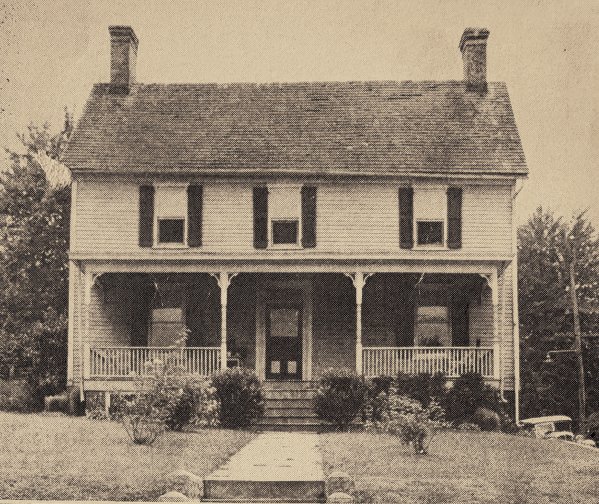 Denise Forman (1761-1822) was the patriot son of Samuel Forman, Sr., the business partner of John Burrowes, Sr. The Forman family home stood (and still stands) on Ravine Drive in Matawan, and all evidence suggests that the celebration was held at this location.
Denise fought at the battle of Germantown and participated in operations against British forces around Sandy Hook. He was taken prisoner with Freneau and was incarcerated in the British prison ship with him. Freneau married Eleanor Forman, Denise’s sister. Late in Freneau’s life, he and Eleanor lived in a Freehold farmhouse owned by Denise.
General Wayne was General Anthony Wayne, who led an attack on the British at the Battle of Monmouth. One of Washington’s senior commanders, he had just secured the Treaty of Greenville with western Native nations in 1795 following his victory at Fallen Timbers.
Governor Howel was New Jersey Governor Richard Howell.
Peter Schenck, Esqr was identified as one of the New Jersey assembly representatives for Monmouth County (The New Jersey Gazette, Wednesday, Oct 21, 1778).
There seems to be little information available about Rev. William Hobrow. The New Jersey Calendar of Wills shows him having a will dated 1800, but we know very little about him – not even his denomination. The identity of Captain Conover is also not clear – there was an abundance of Conovers (originally known as Covenhoven) in the area. A Captain Conover was taken prisoner in the Burrowes Mansion raid in 1778, but the connection is uncertain – the raid was 17 years prior to this event.
The Mount Pleasant Celebration
A second celebration was also held on that day, this one at Thomas Hunn’s tavern in Mount Pleasant. (More information about Hunn can be found at this link.) While not as elaborate as the event at the Forman house, it still featured anti-British toasts and copious gunfire.
On The Fourth of July, 1795, being the day of celebrating the independence of America, a number of respectable inhabitants assembled at 11 A.M. at the house of Major Thomas Hunn, in Mount-Pleasant; as also Capt. Schenck’s company of Light Infantry, at the same place, where an elegant dinner was provided. Mr. Peter Smyth was then appointed President on the occasion. After dinner, the following Toasts were drank; at each toast the infantry performing the platoon firing with the greatest dexterity and exactness.——
-
- May the Fourth of July 1776 ever be kept in remembrance.
- The President of the United States.
- May France humble all her enemies.
- Let Monarchy be buried in eternal oblivion.
- May all nations become independent of kings.
- Peace and unanimity in America.
- Destruction to all despotic powers.
- May the Rights of Man universally prevail.
- May slavery be abolished forever.
- May Liberty be universally known.
- To the memory of the brave Americans under General Greene, in South Carolina, who fell in the action of September 8, 1781.
- Success to trade and commerce.
- Destruction to all treaties made exclusively in British favour.
- May the brave sons of America never suffer the key of Secrecy to be turned on the doors of Government.
- May the pride of Britain fall, like Lucifer, never more to rise.
The greatest harmony and good humour prevailed on the occasion, thro’ the whole company; and at 7 o’clock in the evening the observation of the day was concluded with the utmost unanimity, sobriety, and good order.
(Jersey Chronicle, Saturday, July 11, 1795, p. 93)
Peter Smyth (1749-1824) was a resident of Mount Pleasant, with ties to the Van Pelt family. The toast to the “brave Americans under General Greene” relates to General Nathanael Greene and the Battle of Eutaw Springs fought in South Carolina. Freneau wrote a poem titled “To the Memory of the Brave Americans” honoring the many men lost there. The exact identity of Capt. Schenck is still being determined. It is possible that this was William Schenck, but as there were multiple Schencks in the military, further research is required.
The End of the Chronicle, and its Legacy
Leary wrote that “the Jersey Chronicle was preeminently a voice crying in the wilderness of Monmouth County. It was devoted to the education of its rural subscribers. It taught patriotic republicanism, the right of the common man to fight his way out from under whatever despotism attempted to crush him.” Apparently, Freneau overestimated the receptiveness of his rural audience to this message.
The Jersey Chronicle ran weekly from May 2, 1795 through April 30, 1796, with supplements accompanying some issues. A total of 52 issues were published. On April 30, 1796, Freneau announced that a “necessary number of Subscribers having not yet appeared, scarcely to defray the expenses of the undertaking, notwithstanding the very low rate at which it has been offered, the Editor, with some regret, declines a further prosecution of his plan at this time.”
Like so many of Freneau’s projects, the Chronicle was a financial failure. But its importance in preserving our local history, like these special July Fourth celebrations, is immeasurable.
— Barry Orr
Appendix A.
HYMN TO LIBERTY.
(Tune—God save the king.)
GOD save the Rights of Man!
Give us a heart to scan
Blessings so dear:
Let them be spread around
Wherever man is found,
And with a welcome found
Ravish each ear.
See, from the universe
Darkness and clouds disperse,
Mankind awake;
Reason and Truth appear,
Freedom advances near,
Monarchs, with terror, hear—
See how they quake!
Long have we felt the stroke,
Long have we bore the yoke,
Sluggish and tame:
But now the Lion roars
And a loud note he pours,
Spreading to distant shores
Liberty’s Fame.
Godlike and great the strife,
Life will, indeed be LIFE
(When we prevail),
Death, in so just a cause,
Crowns us with loud applause
And from tyrannic laws
Bid us—ALL HAIL!
(Jersey Chronicle, Saturday, July 11, 1795, p. 93)
Appendix B.
AN ORATION.
[Published by Request of the Audience.] On the Nineteenth Anniversary of American Independence, delivered at Middletown-Point, on Saturday the Fourth of July, 1795, by the Rev. WILLIAM HOBROW, P.S.T.
I RISE, my friends and fellow citizens, deeply conscious of my own inabilities to address you upon so important an occasion as this day demands.
This is the Birth-Day of American Liberty wherein the brave sons of Columbia emancipated themselves from the slavery of Britain, and planted the Tree of Liberty on their wide extended plains; whose fruit is so grateful to the human heart as to have the happy effect to open the eyes of the most potent nations of the earth, to see the “Rights of Man” in their proper colours, too, too long obscured by king-craft and priest-craft, those blood-suckers of the honest and industrious! Yes, Fellow Citizens, This Day is big with the fate of Rome, France, and all Europe. The angel mentioned in the Revelations has flew through the heavens with the joyful message, “The Rights of Man!” and the whole earth is enlightened with its glory; and the Almighty Governor of the universe has honoured America with the first fruits of it; and for which our brethren in arms and fellow citizens, the French armed nation, are now nobly and manfully contending with the despots and tyrants of Europe. That same power which declared they had a right to “bind the Americans in all cases whatsoever,” is contending with our brethren the French, & that same almighty power which fought for America is fighting for them; for the truth of which I appeal to the judgement of every sensible man, and bring their amazing victories over the confeding kings of Europe against “The Rights of Man,” as witnesses, and upon whose success depends the peace of America. May we never forget our brethren who helped us in the hour of distress: May their motto be our’s—LIBERTY or DEATH!
But it was you, my fellow citizens; it was you, my brave Americans, that taught the French to think: It was you who gave them to drink of the nectar drawn from the Tree of Liberty in your own land, when they lent you their friendly aid to cut in sunder the Gordian knot of slavery, and deliver you from the galling yoke of Britain.
And my hearty prayer is joined to your’s that the almighty hand of God may never cease ’till all kingly and tyrannic power (under whatever appearance it may show itself) is totally destroyed, and the whole universe become one grand Republic, and men love like brothers.
When I contrast the pleasing scene which now presents itself to our view with the situation of America two hundred years ago, I own I am struck with wonder and astonishment.—But what is too great for omnipotence?—America, then the habitation of every ferocious beast, and still more ferocious men, whose tender mercies are cruelty itself, and whose inhospitable shores, guarded by these savages, forbade the European foot to tread thereon—when I call to mind the miseries and distresses many of our ancestors underwent when they first made a decent upon our (now happy but then) inhospitable land; driven from their own peaceable habitations for worshiping God according to the dictates of their own consciences by spiritual tyrants, we cannot deny the tear of tribute to their memory; and it loudly calls for gratitude and thanks to that God who has cast our lot in better times.
The words of the Evangelical Prophet Isaiah are fulfilling.—”The Lord hath given thee rest from thy sorrow & from thy fear, and from thy hard bondage, wherein thou (America) wast made to serve; and now thou mayst take up this proverb against this proud king of Babylon and say, How hast the oppressor ceased! The Lord hath broken the staff of the wicked and the sceptre of their rulers: Their pomp is brought down to the grave which did weaken the nation who said in his heart, I will exalt my throne above the stars of God; I will sit upon the mountain of the congregations, in the sides of the NORTH; I will ascend above the heights of the clouds, I will be like the most high, but thou shall be brought down to the sides of the pit, they that see thee shall narrowly look upon thee and consider thee, saying, Is this the man that made the earth to tremble, that did shake kingdoms, that made the world a wilderness and destroyed the cities thereof; that opened not the prison-ship of his prisoners, but let them perish by hundreds, by thousands, and by tens of thousands, by famine and distress!
But I will not, my brethren, wound your feelings any more on this festive day by recapitulating your sufferings in your noble struggle for Liberty, bought with the blood of more than one hundred thousand of your fellow citizens. As the almighty has broken the jaw teeth of the lion and adder, now we dare permit the British Lion to rest near the American Lamb; well knowing he dare not bite or devour in all our mountains.—Let us be humble and thankful for this, and every other mercy.
Turn your eyes! see the huts where the Indian savages formerly dwelt, and wildernesses where the tygers and monsters of the woods made their abodes, cities and towns well built, temples dedicated to the true God (who made all men equal) erected; schools, academies, colleges reared, where science, learning, and the Fine Arts of every description are taught by men educated in your own seminaries, equal, if not superior to any in the European schools.
In this our happy country no purple robed tyrannic bishop can put us into his inquisition, and deprive us of life, and liberty, under pretence of saving our souls!—No lordly rector can now come and rob us of our hay, corn, and every other necessary of life, like the national clergy of Europe, under pretence of tythes. However the people differ from them in religious worship, still must they either feed these belly-gods, these wolves in sheeps clothing, these nag’s-head dubbed bishops, these successors of poor Peter the fisherman!—or—their spiritual courts excommunicate them, and send their souls to hell, and their bodies to prison!
Oh! my fellow citizens, you can never be sufficiently thankful for your deliverance from these spiritual tyrants, these oppressors, these tormentors of the conscience; from that abominable thing called A NATIONAL CHURCH, from king-craft and priest-craft of every description!
How different is the state of religion in America!—Here is no religious test, no lordly bishop to tyrannize over your consciences. All are here equal; all equally start in life, and none are exempted from arriving at the dignity of rulers because of their religious opinions. The son of the poorest man, if he has merit, and has rendered himself capable of it, is equally entitled to be a ruler with the progeny of the rich.
Republicans pay no regard to stars and garters. Merit, with them, is the only requisite. To have the approbation of their constituents is the highest order of our senators; and to have abased the confidence the majesty of the people has reposed in their public servants, the greatest disgrace: enlightened Americans, expect their public servants not only to do well once; but to continue to deserve well of their country, or quit their posts.
Here the liberty of the press, that birth-right of mankind, knows no bounds—Here, the greatest man in power is amenable to the poorest, and is liable to be called to an account for misconduct and abuse of his delegated power any moment; and obliged to resign his commission and stand in the ranks perfectly upon an equality with the meanest citizen soldier.
This new world is now become an Independent Empire, and has acquired a name amongst the nations of the earth; nor does she fear the proudest PITT of them all! America knows nothing of oppressing her citizens by levying taxes to support standing armies in times of peace! her citizen soldiers are sufficient—her commerce amply supplies her citizens with every luxury in return for her produce.—Republicans know no MAN; it is PRINCIPLES they attend to.
Americans have wisely avoided every extreme in their constitution. Her sons of learning have wisely steered clear of, and avoided the rocks and quicksands of either ancient or modern Republics, tyrants only in name, with a new guise.
Americans make laws themselves, and for themselves, and we, the MAJESTY OF THE PEOPLE acknowledge no sovereignty but the LAWS.
Good republicans submit to the laws, because they have a voice in making them.—Have they, through the weakness of human nature, made a law which bears, or seems to bear hard, on any particular description of their fellow citizens?—they hear their complaints, and if they apply in a proper and constitutional way, they redress their grievances.
Justice & equity amongst our judges, courts, and magistrates, is the order of the day. Nor is the majesty of the people ever uneasy to trust the executive sword into the hands of her WASHINGTON.——Washington! that endearing name, who led your armies from conquest to conquest, enduring the same fatigues with his fellow citizen soldiers. Thy name now revered by every true republican, here and in England, in France and in Holland, shall flourish in immortal youth amidst the jar of elements, “the wreck of matter, and the crush of worlds!”
When we strangers view thee and thy brother officers and soldiers, giving up your commissions, retiring from the busy scene of war, without fee or reward, and taking up with the plough share and pruning hook instead of the sword and the halbart, in the humble station of farmers and tillers of the ground, we cannot but feel the same emotions of soul the noble Congress did when you resign’d, and we cryed out in rapture, all hail! you are all heroes, you are all Washingtons.
But how shall we preserve untainted these invaluable blessings to ourselves and posterity?—I answer, 1st. In worshipping and adoring that beneficent hand who gave them us; attending on his worship; praying to him that as he has regenerated our country and delivered our persons from bondage and slavery, bestowing every comfort and convenience for life, he may do the same to our souls, fit and prepare us to live with him eternally, through Jesus Christ.——2dly By teaching and instructing our children, bringing them up in the nurture and admonition of the Lord.——But Christ’s command is, Be wise as serpents as well as harmless as doves.—Therefore we must never forget to teach our children the true policy of America; and in order thereto, we must read and know it ourselves; for ignorance is a dreadful calamity; it is this evil of ignorance keeps the Turks, the Russians, the Poles the Spaniards, & a hundred more, slaves to their several tyrannic masters: and if it had not been for the few men of reading and reflection (during your late contest with Britain) who fought as nobly with the pen as with the sword, America must at this day have been the slaves of Britain, And, like the Turkish Janisaries, commanded by some bashaw of England, either of three stars, three garters, or three tails; and we must, long ere now, have drawn the sword on our French brethren in helping proud PITT to exterminate Liberty from the face of the earth.
I should be wanting in respect to heaven’s last, Best gift to man, were I not to attend to so respectable a company as is now before me of you, ye fair daughters of America. Ye wives and daughters of the magnanimous heroes who nobly fought and bled in defence of the natural rights and liberties of the whole human race (for which nations unborn will revere your names)—Inspired by you, they braved all dangers, seven years’ summer’s drought and winter’s pinching frost seemed to them but a day for their love of Liberty. And their highest ambition was to lay the laurels of the field and of the briny ocean at your feet—your approving smiles made them forget all their toils.
Yes! ye empresses of our hearts, it was for you and your tender offspring all this was done; and in return you cannot give greater proof of your love and affection than in, next to teaching them the way to heaven, to instruct them to tread in the political footsteps of their fathers; pointing out their names in the page of history, and shewing them their noble, their valiant deeds; and when their lisping tongues shall ask, What did my father bleed & die for?—Tell them their country demanded their service to set mankind free and restore them again to the Rights of Man, usurped for ages by foreign despots and spiritual tyrants, assisted by their slaves.
And let me enjoin you, let me beseech you, let me intreat you to teach them this short but comprehensive political creed—Tell them to tell their children, and their children’s children’s children, to grasp it in death, and return it untainted to heaven, That
ALL MEN ARE BORN EQUAL! That all power is derived from the majesty of the People—and with this wish I now take my leave,
May the Sons of America never want courage and resolution to assert the Rights of Man—
And may they never want virtue to be obedient to the laws they make.
(Jersey Chronicle, Saturday, July 18, 1795, p. 97)
NO COMMENTS