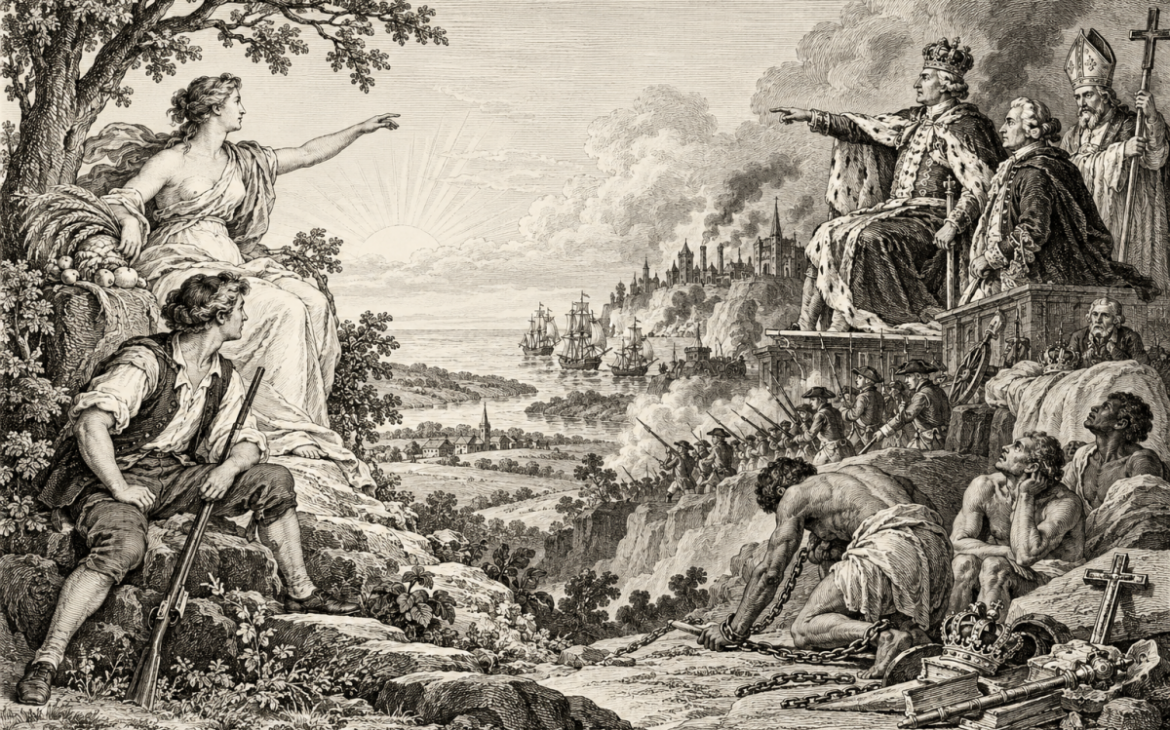
“Reflections on the Gradual Progress of Nations from Democratical States to Despotic Empires” was written by Philip Freneau in 1799. His 1815 version of the work was included in Volume III of Fred Lewis Pattee’s The Poems of Philip Freneau – Poet of the American Revolution (1907). The poem describes the structural collapse of liberty and the ever-present danger of a slide into monarchy. In a 1949 article titled “Classical Echoes in the Poetry of Philip Freneau,” Classics scholar Ruth Wentworth Brown noted that “… it is startling to observe that this poem, published in 1815, voices forebodings that trouble men’s minds today.” This is no less true in 2026.
“Reflections…” was featured in an August 2026 article by poet and musician Frank Hudson: From Philip Freneau’s “Reflections” or Darkness on the Edge of Town. Hudson presents a succinct mini-biography of Freneau and then describes the process by which he set the piece to music. The result is a unique fusion of Freneau’s spoken words with an electric guitar-focused rock composition.
— Barry Orr
Reflections on the Gradual Progress of Nations From Democratical States to Despotic Empires
Mantua vae miserae nimium vicina Cremonae! Virgil.
OH fatal day! when to the Atlantic shore
European despots sent the doctrine o’er,
That man’s vast race was born to lick the dust;
Feed on the Winds, or toil through life accurst;
Poor and despised, that rulers might be great
And swell to monarchs, to devour the state.
Whence came these ills, or from what causes grew,
This vortex vast, that only spares the few,
Despotic sway, where every plague combined,
Distracts, degrades, and swallows up mankind;
Takes from the intellectual sun its light,
And shrouds the world in universal night?
Accuse not nature for the dreary scene,
That glooms her stage or hides her heaven serene,
She, equal still in all her varied ways,
An equal blessing to the world displays.
The suns that now on northern climates glow,
Will soon retire to melt Antarctic snow,
The seas she robb’d to form her clouds and rain,
Return in rivers to that source again;
But man, wrong’d man, borne down, deceived and vex’d,
Groans on through life, bewilder’d and perplex’d;
No suns on him but suns of misery shine,
Now march’d to war, now grovelling in the mine.
Chain’d, fetter’d, prostrate, sent from earth a slave,
To seek rewards in worlds beyond the grave.
If in her general system, just to all,
We nature an impartial parent call,
Why did she not on man’s whole race bestow,
Those fine sensations angels only know;
Who, sway’d by reason, with superior mind
In nature’s state all nature’s blessings find,
Which shed through all, does all their race pervade,
In streams not niggard by a despot made?
Leave this a secret in great nature’s breast,
Confess that all her works tend to the best,
Or own that man’s neglected culture here
Breeds all the mischiefs that we feel or fear.
In all, except the skill to rule her race,
Man, wise and skillful, gives each part its place:
Each nice machine he plans, to reason true,
Adapting all things to the end in view,
But taught in this, the art himself to rule
His sense is folly, and himself a fool.
Where social strength resides, there rests, ’tis plain,
The power, mankind to govern and restrain:
This strength is not but in the social plan
Controling all, the common good of man,
That power concentred by the general voice,
In honest men, an honest people’s choice,
With frequent change, to keep the patriot pure,
And from vain views of power the heart secure:
Here lies the secret, hid from Rome or Greece,
That holds a state in awe, yet holds in peace.
See through the world, in ages now retired,
Man foe to man, as policy required:
At some proud tyrant’s nod what millions rose,
To extend their sway, and make a world their foes.
View Asia ravaged, Europe drench’d with blood,
In feuds whose cause no nation understood.
The cause we fear, of so much misery sown,
Known at the helm of state, and there alone.
Left to himself, wherever man is found,
In peace he aims to walk life’s little round;
In peace to sail, in peace to till the soil,
Nor force false grandeur from a brother’s toil.
All but the base, designing, scheming, few,
Who seize on nations with a robber’s view,
With crowns and sceptres awe his dazzled eye,
And priests that hold the artillery of the sky;
These, these, with armies, navies, potent grown,
Impoverish man and bid the nations groan.
These with pretended balances of states
Keep worlds at variance, breed eternal hates,
Make man the poor base slave of low design,
Degrade his nature to its last decline,
Shed hell’s worse blots on his exalted race,
And make them poor and mean, to make them base.
Shall views like these assail our happy land,
Where embryo monarchs thirst for wide command,
Shall a whole nation’s strength and fair renown
Be sacrificed, to prop a tottering throne,
That, ages past, the world’s great curse has stood,
Has throve on plunder, and been fed on blood.—
Americans! will you control such views?
Speak—for you must—you have no hour to lose.
(1815 text)
(Image by ChatGPT, 2026)
NO COMMENTS