The history of education in Middletown Point and Matawan is not the history of a single school system. It is a succession of educational arrangements that followed the community’s own transformation: an eighteenth-century village schoolhouse; small neighborhood district schools; ambitious private academies; a consolidated graded school; a modern high school; and finally a regional district serving a rapidly suburbanizing Borough and Township.
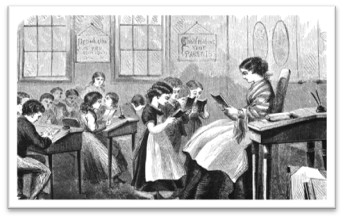
The earliest presently identified reference is a March 24, 1761, road record describing a route near a schoolhouse at Middletown Point. By the nineteenth century, education was dispersed among local district schools. In 1851 records define Matawan School District No. 1, Brown’s Point District No. 15 and Oak Grove District No. 12; in 1853 the boundaries of Lower Middletown Point District No. 4 were recorded. This decentralized system persisted into the late nineteenth century.
Alongside the public district schools grew a remarkable private-school tradition. Middletown Point Academy was operating in 1834 and expanded rapidly. Its institutional descendants—the Collegiate Institute of Middletown Point, Glenwood Institute and ultimately Matawan Military Academy—gave the village an educational reach well beyond its size. The private academy tradition and the public district-school tradition overlapped for decades.
The decisive public-school transition came in 1895, when the older district arrangement gave way to a consolidated graded system. An eight-room school was erected at Broad and Church Streets for $16,000. Growth required a major addition in 1908. A separate high school followed in 1924, and subsequent construction reflected both population growth and changing expectations for secondary education.
The final transformation came after World War II. The Borough and Township formed a regional school district in 1961. A new regional high school opened in 1962, followed in quick succession by Strathmore, Ravine Drive, Lloyd Road and other facilities. A 1966 district publication projected enrollment above 7,000 by 1969–70 and 7,381 by 1970–71. By 1970, the educational landscape bore little resemblance to the small district schools of the nineteenth century.
The Earliest Schooling at Middletown Point
The oldest school reference presently located for Middletown Point predates the Revolution. The 1885 History of Monmouth County reproduces a March 24, 1761, road record describing a road running toward Middletown Point Landing near a schoolhouse on the Point. The record does not tell us when that school was established, how it was governed, or who taught there. It does, however, establish that a recognizable schoolhouse existed in the community by 1761.
The same nineteenth-century history describes an early schoolhouse near the Presbyterian burial ground and associates it with the schooling of Asbury Fountain around 1815. The building reportedly remained in use, with repairs, until about 1850.
Early schooling was local, small-scale and geographically dispersed. The later system of numbered districts, elected trustees, graded classes and centralized facilities developed incrementally rather than springing from a single eighteenth-century institution.
District Schools
MHS instituted “Project 1850” earlier this year. This is an ongoing effort to examine the demographics of mid-19th century Middletown Point using 1850 census data. That census was the first to name every free person individually, along with twelve other data points, including identifying all who attended school within the previous year.
The enumerator of the census, Simon Arrowsmith (1799-1890), was a prominent Middletown Point resident. He specifically marked what he considered the town on the census record as an area from what is now a point between Routes 516 and 34 to slightly past the train station on Main Street, with a few homes a block or so off this center line included. It did not include Mount Pleasant or the area then referred to as “Africa” – what is now Johnson and Atlantic Avenues. While these areas were covered in the census, they haven’t to date been incorporated into the Project 1850 study.
There were 668 inhabitants of the Middletown Point designation in Arrowsmith’s enumeration, with 157 children from ages 6 to 16. Of these children 101 were designated as having attended school the previous year.
Three teachers were named – William Weed (c. 1805-?), Philetus Philips (1804-1881) and William Parker (1802-1865). Parker was associated with the Matawan Academy, as was Phillips, although Phillips may have been involved with a separate “ladies academy” in the 1850s. Weed’s teaching duties are unknown at this time.
By the middle of the nineteenth century, the surviving records show a recognizable district-school structure. Aberdeen Historian Edward Fitzgerald’s education chronology, prepared from township records and newspaper material, records the formal setting of boundaries in 1851 for Matawan School District No. 1, Brown’s Point School District No. 15 and Oak Grove School District No. 12. Lower Middletown Point School District No. 4 followed in the surviving chronology in 1853.
In January 1855, the trustees of Matawan School District No. 1 purchased a half-acre lot for a school. Fitzgerald identified that parcel as the site of the later Cliffwood School and described it as the oldest site in the Matawan-Aberdeen district in continuous educational use.
A later local account, “Old District Schools,” recalls the landscape before consolidation: Mount Pleasant, the Middle District school on Church Street, a Lower Matawan school near Rabbit Lane, and a Cliffwood district school. These were small neighborhood institutions, generally two-room schools. The arrangement placed schools near the populations they served, but it also produced separate boards, facilities and tax decisions.
The records give unusually vivid glimpses of how local this system was. In 1884 District No. 47 voted a special $150 tax to continue the school year and meet incidental expenses. In 1886, the clerk of the Lower Matawan district reportedly appeared for a legally required school election and waited until nearly 9 p.m.; no voters came, and the county superintendent later reappointed a trustee. Such episodes show education being administered at the scale of individual neighborhoods.
Race, the “Colored School,” and Integration in 1882
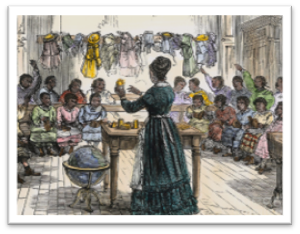
One of the most consequential episodes in the surviving school record concerns the separate school for Black children. Fitzgerald’s chronology records a July 18, 1882, joint meeting of trustees from the Mount Pleasant, Middle District and Lower Matawan Schools, presided over by County Superintendent Samuel Lockwood. Among the matters discussed was the closing of the “Colored School” associated with St. James Church.
On August 30, Lockwood wrote to A. H. Harris, the vice president of the Monmouth County Sunday School Association and patriarch of the family associated with Harris Hardware in Matawan, that the separate school had to be disbanded and that its pupils would thereafter attend the regular district schools. His letter, published in the Matawan Journal on September 9, explained that the trustees responsible for supporting the separate school had declined to continue their financial contribution. Lockwood therefore concluded that the school could no longer operate under the existing arrangement. His letter also makes clear that the change was not intended to end public education for Black children; rather, they were to be incorporated into the three existing district schools according to their places of residence.
 The decision immediately generated public discussion. On September 16, trustees of District No. 48 published a response defending their actions. They emphasized the financial burden placed upon their district, noting that only four Black children then resided within it and arguing that the amount being assessed for the separate school was disproportionate to the number of pupils involved. They also stated that the question had been discussed at the July 18 joint meeting of the three boards and that a majority of the trustees present favored their position. Their response therefore framed the closing largely as a matter of equitable allocation of public-school funds rather than opposition to educating Black children.
A very different position appeared in the Journal on September 23. That anonymous correspondent criticized the withdrawal of funding and argued explicitly for maintaining a separate school for Black children. The writer contended that Black residents should have schools of their own, taught by Black teachers, rather than having their children educated in racially mixed schools. The letter is significant because it demonstrates that the controversy was not simply about finances or administrative boundaries. The desirability of racial separation itself was being publicly debated.
The discussion continued into October. In the October 7 Journal, an anonymous correspondent signing himself “A Resident Tax-Payer” defended the decision to close the separate school. He emphasized that the action represented the judgment of the three boards of trustees rather than the Lower District alone and claimed that, after speaking with “a large number, both of white and colored,” he found considerable support for the decision. He further stated that another district taxpayer, whose children included both white and Black children, had specifically requested that the separate school be abandoned. These assertions are important contemporary testimony, although, because they come from an anonymous advocate in the dispute, they cannot by themselves establish the actual balance of opinion among Matawan’s Black residents.
The October 7 correspondent also advanced an argument that went beyond financial considerations. He maintained that “the true policy” was to educate Black children by giving them access to the advantages of the regular public schools and removing barriers to their advancement. He argued that the trustees were obligated to act impartially for the benefit of children “regardless of nationality or color” and maintained that Black pupils would receive greater educational opportunities in the regular schools under experienced teachers. His language reflected the paternalistic assumptions common to the period, but his position nevertheless stood in direct contrast to the September 23 correspondent’s advocacy of separate Black schools and Black teachers.
Taken together, the surviving correspondence assists our understanding of the episode. The closing of the Colored School was not merely an administrative consolidation prompted by finances. It became a public debate involving taxation, educational quality, the responsibilities of local school trustees, racial separation, and whether Black children would be better served in a separate institution or in Matawan’s regular public schools. The newspaper exchange preserves opposing contemporary positions: one writer explicitly defended continued racial separation, while another defended the trustees and argued that Black children should receive the benefits of the regular public-school system.
The surviving evidence does not allow us to determine with confidence how Matawan’s Black community as a whole viewed the change. Statements concerning Black support or opposition appeared within argumentative letters and should therefore be treated as claims by the participants rather than as demonstrated community consensus. What the record does establish is that racial integration was explicitly at issue in the public discussion and that the administrative decision ultimately ended the separate-school arrangement. Fitzgerald’s chronology records February 24, 1883, as the final appearance of the “Colored School” in the annual school financial report. The 1882–83 episode therefore marks an important transition in Matawan’s educational history: Black children who had previously been educated through a separate school were thereafter directed into the community’s regular district schools.
Middletown Point Academy and the Private-School Tradition
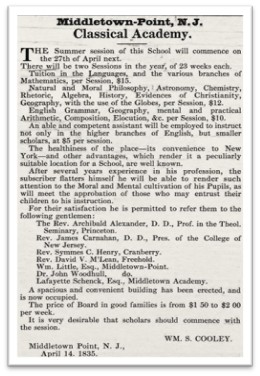
Middletown Point Academy was already operating in the spring of 1834, initially on a very small scale. As interest increased, local supporters met at the bank office on August 16, 1834, and organized a stock company consisting of twenty-two $50 shares. On September 6 they authorized construction of a two-story schoolhouse measuring 44 by 26 feet, and on October 11 contracted with T. D. Simpson to erect it for $1,020. The stockholders formally organized in February 1835, and the first term in the new building began 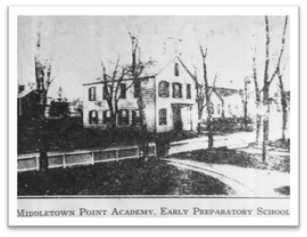 April 27 under principal William S. Cooley. The site was the corner of Church and Jackson Streets, corresponding to what is now 13 Church Street. Prominent Matawan resident William Little was instrumental in the schools founding – its first two pupils were his children, Henry Stafford and Margaret.
 Philetus Phillips assumed charge on August 1, 1836, and remained until January 1844. During his tenure the Academy developed into a substantial coeducational institution. An 1838 catalogue lists 84 students—45 males and 39 females – and an ambitious curriculum extending from ordinary English subjects to Latin, Greek, French, higher mathematics, philosophy, chemistry, botany, astronomy, rhetoric and logic. Students came from outside the immediate community and could board with local families. The Academy consequently represented something quite different from the small neighborhood district schools then serving the surrounding countryside.
The history of the Church and Jackson Street building did not end when the private Academy outgrew it. The Academy began receiving public money about 1845, and in 1851 the stockholders leased the building to the local school district. In 1857 the Academy organization raised $2,000, purchased a lot across Church Street and erected the nucleus of the larger institution at present-day 10 Church Street. The private school moved across the street and subsequently evolved into the Collegiate Institute of Middletown Point, Glenwood Institute and eventually Matawan Military Academy.
The original Academy building remained in educational service, however, becoming the Middle District Public School, District No. 47. Thus, the same structure that had housed Phillips and the prestigious private Academy of the 1830s and 1840s subsequently educated generations of local public-school children. District No. 47 was one of the three districts involved in the 1882 controversy over discontinuing Matawan’s separate school for Black children, and in 1884 its voters approved a special $150 tax to extend the school year and pay incidental expenses. David Provost Van Brackle taught there during the 1889–90 and 1890–91 school years.
The building finally ceased serving as a school in 1895, when Matawan’s new consolidated graded-school system superseded the old district arrangement. It was subsequently moved from the Church and Jackson Street site to the foot of Church Street and converted to residential use. The original building therefore had an educational life of approximately sixty years, from 1835 to 1895, spanning Matawan’s transition from a privately financed academy to a district-based public-school system.
Of interest is the account of Matawan chronicler Dottie Herbert Yeargin who lived in the structure after it had been moved to the end of Church Street. She advised that when her father was renovating an interior room and removed a wall, a large chalkboard was underneath with turn of the century writing on it. The building was demolished in 2007/8, and a new duplex was built on the lot.
From the Collegiate Institute to Glenwood Institute
When the stockholders of the old Middletown Point Academy erected a new school building on what is now 10 Church Street in 1857, they were doing considerably more than simply relocating the earlier academy. The new institution, known initially as the Collegiate Institute of Middletown Point, represented an expansion of the educational enterprise that had begun in Matawan in the 1830s. The academy stockholders subscribed $2,000 toward construction of the new building, which would eventually develop into the large structure still standing on the site.
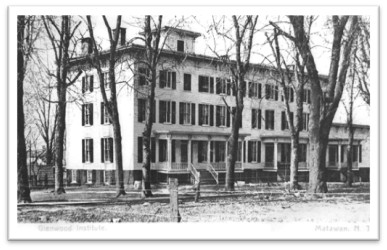 Henry Sabin became principal in 1859 and remained until sometime after 1862. During his administration, students even published a monthly paper, the Monthly Offering. Sabin was succeeded by Professor A. T. Howard, and it was Howard who gave the school the name by which it would become best remembered: Glenwood Institute. J. H. Hamilton became principal in 1872 and served for two years. On September 10, 1874, Charles Jacobus assumed control of the school, beginning one of the most important periods in its history. Under Jacobus the building was substantially enlarged to approximately the dimensions familiar today.
There is a minor discrepancy among the surviving accounts concerning the precise date of this expansion. Presbyterian Pioneers at Matawan also attributes the Glenwood name to Professor Howard but places the substantial enlargement of the building in 1876. The sources nevertheless agree on the larger sequence: the Collegiate Institute became Glenwood under Howard, and the institution underwent a major physical expansion during the Jacobus era in the mid-1870s.
A Regional Boarding and Preparatory School
A surviving 1872–73 Glenwood Institute catalogue provides an unusually detailed picture of the school and the manner in which it marketed itself. Glenwood emphasized Matawan’s location approximately thirty miles from New York City and two miles from Raritan Bay. Students traveling from New York could take the steamer Matteawan to Keyport, while the catalogue looked forward to completion of the New York & Long Branch Railroad as a faster means of reaching the school. Students coming from Philadelphia could travel by the Camden and Amboy Railroad to Old Bridge and then make the approximately six-mile journey to Matawan by road.
The catalogue also provides a valuable description of the physical plant. Glenwood’s schoolrooms, classrooms and boarding facilities were contained in a three-story building approximately ninety feet long and thirty-six feet wide, constructed specifically for educational purposes. Boys and girls were housed in separate sections of the building, and the structure included dormitory accommodations and an observatory. Glenwood was much more than a neighborhood private school – it was a purpose-built, coeducational boarding and preparatory institution designed to attract students from outside the immediate community.
That regional reach is confirmed by later accounts. The 1936 Matawan Journal retrospective reported students coming from New York City, Long Island, St. Louis and New Orleans. During the prosperous Jacobus years, students reportedly arrived from many directions by train, and some families moved to Matawan so their children could attend the Institute. Glenwood’s reputation and student body extended well beyond Matawan.
Faculty, Curriculum and Distinguished Students
Glenwood offered a surprisingly broad curriculum. By the 1884–85 academic year, Charles Jacobus, A.M., served as principal and taught Latin, Greek and physics. Carrie A. Beegle taught music and French; Albert H. Wilson taught English, mathematics and bookkeeping; Julia A. Kuech taught history and German; and Helen V. Nathans supervised the primary department. The combination of classical languages, modern languages, science, mathematics, history and commercial subjects illustrates the school’s dual purpose. It could prepare a student for college while also providing practical education useful to those entering business or professional life.
The institution’s influence is also reflected in the careers of people associated with it. Garret A. Hobart, later Vice President of the United States under President William McKinley, attended the school in 1859. Joseph D. Bedle, who later became governor of New Jersey, was another student, and the 1936 Journal identified future New Jersey attorney general Edmund Wilson among those who attended during the Jacobus period. Novelist Miriam Cole Harris (1834-1925) attended in the mid-19th century.
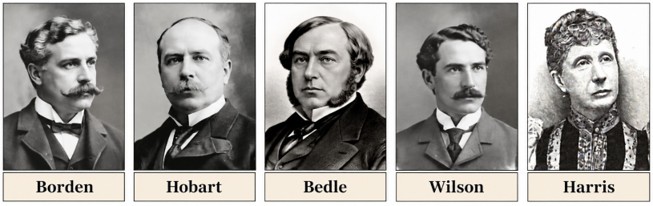 Perhaps the school’s most remarkable international connection was Robert Laird Borden. The young Canadian came to Matawan at about nineteen years of age in 1873 and taught at the school. Thirty-seven years later he became Prime Minister of Canada and subsequently received a knighthood. For a private school in a relatively small Monmouth County community to have educated or employed individuals who would later become a United States vice president, a New Jersey governor and attorney general, and a Canadian prime minister is a measure of the institution’s unusual reach.
An interesting event happened as I was editing this paper. MHS was contacted by a PhD Candidate from the University of Illinois querying about the Glenwood Institute. He was researching a 13-year-old Puerto Rican student attending Glenwood with a dozen young men from Cuba in 1899-1900 and wondered why they were attending this school. My theory is that it appeared wealthy inhabitants of those islands, realizing that both had recently became US possessions after the Spanish American War, sent their children to make connections and learn about the United States. The young man eventually established residency in New York City and was involved with automobile exports to Puerto Rico. This is a perfect example of how the study of history is ever evolving.
Glenwood and the Matawan Community
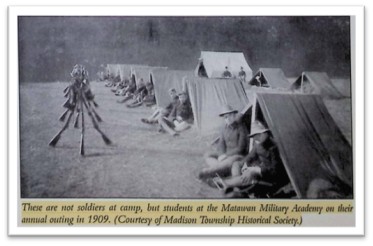
Although Glenwood was a private institution drawing students from outside the community, it was closely integrated into Matawan life. Its relationship with the First Presbyterian Church was particularly strong. Presbyterian Pioneers at Matawan recalled that the school was generally regarded as Presbyterian in character because students and teachers regularly attended the church, although the surviving evidence does not establish that Glenwood was formally owned by the congregation. Some of the boys received military training and marched to Sunday services in uniform.
 The school’s female students also participated in local religious and charitable activity. On April 26, 1884, sixteen Glenwood Institute girls met with Mrs. Robert J. Kent, wife of the Presbyterian minister, and organized the Glenwood Mission Band. Cassie Whitlock was elected president and Edith Jacobus, daughter of principal Charles Jacobus, became treasurer. The girls made clothing for missionary work and raised money through food sales, plays, suppers, fairs and other activities. The episode illustrates how thoroughly Glenwood’s students became part of the social and religious life of the community.
The Development of Military Training
The transformation of Glenwood into the Matawan Military Academy did not occur as abruptly as the change of name might suggest. Military instruction appears to have been introduced at Glenwood well before 1908. The 1936 Matawan Journal history states that principal J. Calvin Rice introduced a military system at the school, and the Presbyterian history independently recalls Glenwood boys receiving military training and marching to church in uniform.
The evidence therefore suggests an evolution rather than a sudden conversion. Glenwood remained principally a boarding and preparatory school while military training became one component of its program during the late nineteenth century. Eventually that component assumed greater importance and provided the foundation for the institution’s final incarnation as a full-fledged military academy.
Matawan Military Academy
The decisive change came in 1908, when Colonel Charles J. Wright purchased a controlling interest in the capital stock of Glenwood Institute. Wright intended to improve the property and transform the school’s curriculum. Among the changes attributed to him was a particularly ambitious language requirement under which students and staff were expected to speak German.
The surviving photograph of the 1908 Matawan Military Academy basketball team, posed on the porch of the old Glenwood building, provides a tangible connection between the two institutions. The building had not changed its fundamental educational purpose overnight; rather, an established nineteenth-century boarding academy was being adapted to the increasingly popular military-school model of the early twentieth century.
The military designation should also not obscure the breadth of the school’s educational mission. The academy continued the preparatory tradition of Glenwood while combining academics with military discipline, physical training and athletics. In that sense, 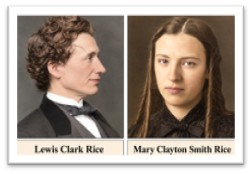 Matawan Military Academy represented the final stage of an educational institution that had repeatedly adapted itself over the course of more than three-quarters of a century.
Raritan Seminary
A second private educational institution operated in Middletown Point during the mid-nineteenth century alongside the Middletown Point Academy. Known as Raritan Seminary, it was headed by Lewis Clark Rice and occupied a building known as Raritan Hall. A contemporary December 1854 newspaper notice advertised a festival and supper at the “Seminary Building, Raritan Hall, Middletown Point,” organized to help establish a community library. Another account identifies Rice as principal of the Seminary and states that the new Social Library Association of Middletown Point and Keyport would maintain its collection in the Seminary building. The 1855 map of Middletown Point provides especially important evidence, separately depicting “Raritan Seminary—L. C. Rice Principal” and Philetus Phillips’s academy, demonstrating that the two schools were distinct institutions operating contemporaneously. The structure stood near the entrance to today’s Prospect Point Gardens on Wycoff Street. Rice’s wife Mary, according to her obituary, had been a teacher in her “younger days”.
The End of the Academy Era
Ultimately, the greatest challenge facing Glenwood and the Matawan Military Academy came not from another private institution but from the growth of free public secondary education. The 1936 Matawan Journal account recalled that Glenwood had been prosperous during the Jacobus years but lacked an endowment. As public high schools developed and increasingly provided the advanced education that once had been available primarily through private academies, Glenwood’s preparatory function declined.
The school finally closed in 1915, bringing to an end approximately eighty-one years of institutional development that had begun with the Middletown Point Academy in 1834. The succession of names – Middletown Point Academy, Collegiate Institute of Middletown Point, Glenwood Institute and Matawan Military Academy – can obscure the fact that these were successive stages in essentially the same remarkable local educational tradition.
Its closing also marked the end of an educational model. During much of the nineteenth century, the Academy and Glenwood Institute had provided college preparation, languages, science and advanced instruction that the small district schools could not offer. By the early twentieth century, Matawan’s expanding public-school system was increasingly able to provide those opportunities without tuition. As Matawan’s public-school system expanded and increasingly offered the advanced instruction once supplied by private academies, the educational niche occupied by Glenwood and its successors narrowed.
The legacy did not disappear entirely. The old Glenwood building survived and was ultimately converted to residential use. Even more appropriately, the 1936 Journal reported that the Institute’s Alpha Xi library was incorporated into the Matawan library, where some of its volumes could still be found decades later. Thus, even after the school itself vanished, a portion of the educational institution that had served Matawan for generations continued to serve the community.
1895: From District Schools to a Modern Graded System
1895 marked a fundamental change in public education in Matawan. Until then, children in the community had been educated in a collection of small district schools, each operating with considerable independence. The Mount Pleasant, Middle District and Lower District schools were among those serving the area. The curriculum varied from school to school and generally extended no further than the seventh year. The decision to consolidate these schools and establish a central graded school therefore represented much more than the construction of a new building: it created the foundation of a unified public-school system.
The change did not come easily. According to a later history of the schools, the proposal for a central school had been placed before Matawan taxpayers several times before voters finally approved it. Bonds totaling $16,000 were issued for construction and equipment. The resulting two-story building contained eight classrooms, four on each floor, together with a library above the lower hall. Basement rooms provided indoor play areas during inclement weather. Despite the modern character of the new school, some conveniences that would later be taken for granted were still absent. The original building had no indoor toilets; pupils used outdoor privies. Indoor sanitary facilities were added later as the school was enlarged and modernized. Contemporary state education officials nevertheless regarded the new building favorably, describing its modern heating and ventilation and pointing to Matawan as an example of the possibilities offered by school consolidation.
The first Board of Education overseeing the new system consisted of Henry Arrowsmith, president; George B. Shepherd, district clerk; Richard 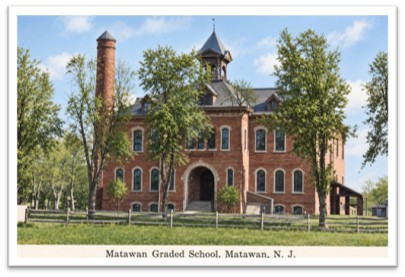 Bedle, George A. Fountain, William H. Coward, Benjamin F. S. Brown, Charles C. Hulsart, Charles E. Close and Francis C. Bedle.
The Transition of 1895
The new building was not ready when classes were scheduled to begin in September 1895. Consequently, Matawan’s new consolidated school system existed administratively before it existed physically. Its newly organized faculty initially continued teaching in the old district school buildings.
William A. Miller, the first principal, taught in the Middle District School together with vice principal Joseph F. Walker and Mary Brown. Gertrude Pullen Pettit and Anna McConachy taught at Mount Pleasant, while Laura K. Bergen and Josephine Ivins Knecht taught in the Lower District School. Once the new building was completed, teachers and pupils were finally brought together under one roof.
Among the furnishings of the new school was a Chickering grand piano acquired in 1895. Its acquisition was itself unusual. According to the later history of Matawan’s schools, the piano was obtained through a promotional contest conducted by the New York Press, in which supporters collected coupons or votes to secure the instrument for the school. The piano remained associated with the Graded School for decades, a tangible survivor from the school’s opening year. Together with the building’s library, basement play areas—and, less impressively, its original outdoor toilet facilities – it offers a glimpse of what everyday school life was like when Matawan’s new educational system began.
Miller would remain principal until 1919 and became the central figure in the development of the new system. Walker also appears to have played an important role in its early organization. The task facing them was substantial. Consolidation required not merely moving children into a common building but establishing uniform grades, curricula and educational standards where previously several largely independent district schools had existed.
When the Graded School opened, 277 pupils were enrolled. Matawan initially employed seven teachers. In June 1896, 147 pupils presented themselves for examination; 135 completed the examinations and 106 passed. These figures provide an unusually useful benchmark against which the rapid development of the school over the next decade can be measured.
Grammar School and the Beginnings of a High School
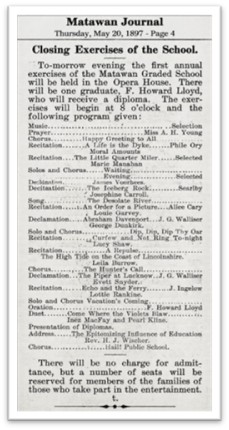 The graded system quickly began producing results beyond the elementary level. In 1898, only five pupils received County Grammar School diplomas; six followed the next year. Within a decade, however, the annual number had risen to approximately twenty or more.
At the same time, a secondary-school program was developing within the Graded School. In 1898 the first class completed what was then a two-year high-school course. The curriculum initially lacked foreign languages, but by 1900 Latin and German had been added and Matawan’s program had gained sufficient standing for the school to be placed on the accepted list of Rutgers College.
The surviving commencement program for 1900 provides a particularly revealing snapshot of this transitional period. The exercises were explicitly announced as those of the “Matawan High School, Class of 1900,” yet High School and Grammar School graduates participated in the same commencement. The ceremony was held at Washington Hall on May 25.
There were only three High School graduates that year: Maude Aumock, Joanna Carroll and Richard Heuser. The Grammar School graduating class was considerably larger, consisting of Charles Elmer Barker, Le Roy Cook, Laura Hawkins, Emerson Jackson Lisk, Mabel Nathans Stilwell, Mabel Adelaide Smith, Jennie Mabel Brown, Louisa Justine Edwards, James Arthur Hawkins, Inez Frances Mackey, Ella Henrietta Quackenbush, Eva Harriet Winter and Nellie Theadosia Whalen.
Commencement was also very much a community event. Students presented essays, recitations, music and orations. Joanna Carroll spoke on “Wisdom or Wealth,” Maude Aumock on “Kindness to Animals,” and Richard Heuser delivered an oration on the very contemporary subject of “Trusts.” Jennie Mabel Brown gave a recitation entitled “The Old Violin.” County Superintendent John Enright presented the diplomas, while State Superintendent C. J. Baxter delivered the commencement address.
The program is important for another reason. It demonstrates that the terms Graded School, Grammar School and High School did not initially denote three separate institutions or buildings. Grammar and high-school instruction developed as different levels within Matawan’s increasingly sophisticated consolidated school system.
Success Brought Overcrowding
The new system expanded remarkably quickly. Indeed, the school appears to have begun experiencing growing pains almost from the beginning. By 1899—only about four years after the Graded School opened—the Board of Education was already seeking funds for additional space and improved equipment.
A May 1899 proposal asked voters to authorize $9,000 for an addition and another $3,000 for heating and equipment. The stated concern was overcrowding and the need to provide room for children entitled to attend the public school. The school election also provides an interesting glimpse of the period: women were eligible to participate in the school vote, and the polling arrangements specifically took their participation into account.
Whether or not that particular proposal provided temporary relief, it did not resolve the underlying problem. Enrollment, curriculum and the number of grades being taught continued to expand.
The Development of the High School
During the first decade of the twentieth century, the secondary program evolved from a modest extension of the graded curriculum into a recognizable high school. The surviving records suggest a progression rather than a single moment at which a separate “Matawan High School” suddenly came into existence.
Miller and his colleagues gradually expanded the course of study and raised academic standards. The system eventually reached the point at which its graduates were accepted by colleges without entrance examinations. The state first recognized Matawan as a three-year high school, and continued development of the curriculum ultimately produced a complete four-year secondary course.
The transformation can be measured in the size and scope of the entire system. The seven-teacher organization created in 1895 had grown by 1908 to 14 teachers serving 386 pupils. The curriculum now extended from kindergarten through eight elementary grades and into high-school work. Music and drawing had been added to the program, and the number of pupils participating in examinations had increased dramatically even though the population of the community itself had not grown at a comparable rate.
Education in Matawan was becoming both more extensive and more structured.
The 1908 Expansion
By 1907 the shortage of space had again become acute enough to require a major enlargement of the school. Plans called not merely for additional classrooms but for facilities reflecting the changing role of the school in community life. The proposed addition included a large assembly room and stage, additional instructional space, improved ventilation and basement accommodations that could eventually permit the introduction of manual training.
The project was completed in 1908 at a cost of approximately $22,000. The addition nearly doubled the size of the original 1895 building. Its most prominent feature was a second-floor auditorium capable of seating approximately 450 people, providing a space suitable not only for school exercises but for large public gatherings.
The expansion represented a remarkable investment when compared with the $16,000 originally borrowed for the entire school and its equipment only thirteen years earlier.
1908: A Mature Public-School System
The year 1908 provides a natural endpoint for this formative period. Looking back over the preceding thirteen years, William A. Miller could point to a school system fundamentally different from the one he had inherited in 1895. Separate district schools with differing programs had given way to a centralized graded system. Enrollment had grown from 277 pupils to 386. The teaching staff had doubled from seven to fourteen. Grammar-school graduation had become routine rather than exceptional, and a secondary program that began as a two-year course had developed into a complete high-school curriculum.
1908–1924: Growth, Expansion, and a Separate High School
The completion of the large addition to the Matawan Graded School in 1908 might have appeared to solve the community’s educational needs for many years. The addition nearly doubled the size of the original 1895 building and included a second-floor auditorium capable of seating approximately 450 people. At the same time, Matawan’s secondary program achieved recognition as an approved four-year high school. The school that had begun thirteen years earlier as an experiment in consolidating several small district schools had become a substantial educational institution.
The expansion, however, did not end the problem of space. Instead, the success of the consolidated system and the continued growth of both elementary and secondary education eventually placed new demands upon the building.
A High School Takes Shape
The years immediately following the 1908 expansion provide some of the clearest evidence that a recognizable high-school culture was developing within the Graded School. The High School still occupied the same building as the younger grades, but its students increasingly had their own curriculum, commencement exercises, musical organizations and traditions.
The Class of 1909 contained seven graduates. Its commencement was held in the High School Assembly Room on June 10 and already had the character of a substantial public ceremony. Students presented essays on subjects ranging from “Heroes of Peace” and “Liberty Under Law” to “The Awakening of China,” while the program included an orchestra, chorus, quartet and High School Glee Club.
Five years later, the Class of 1914 also numbered seven, but its commencement program demonstrates the increasingly sophisticated subjects being addressed by Matawan students. Lillian Doty spoke on New York City’s new water-supply system; Margaret Bruce discussed historic places in New Jersey; Emma Burlew argued “Why Child Labor Should Be Abolished”; and salutatorian Mary Lisk addressed the limitations of arbitration. Geraldine Brown, one of the honor students, delivered the valedictory on “Heroes of the Polar Regions.”
These programs provide a useful reminder that commencement was not simply a diploma ceremony. Students were expected to research, write and publicly present serious subjects before their families and community.
School Life Beyond the Classroom
Music had also become an established part of school life. The commencement programs regularly mention orchestras, choruses, soloists and glee clubs. By 1909 the High School had its own Glee Club, and by 1914 the Boys’ Glee Club was performing at commencement.
The large auditorium added in 1908 was therefore important for more than relieving overcrowding. It provided a setting for commencement exercises, musical performances, assemblies and public activities. Surviving Board records from the following decade even contain regulations governing the use of the auditorium by outside organizations, demonstrating that the school had become a community gathering place as well as an educational institution.
The World Enters the Classroom
The surviving 1917 commencement program, prepared only two months after the United States entered the First World War, offers a particularly striking snapshot of the period. Nine students graduated that June. Salutatorian August Munning delivered an oration entitled “The New Russia,” an unmistakably contemporary subject in the year of the Russian Revolution. Margaret Layton was valedictorian, speaking on “American Humor in Literature.” The ceremony also included an orchestra, piano trio, Boys’ Glee Club and a student presentation of a gift to the school.
Unfortunately, the official school minutes from July 1914 through May 1920 are missing, leaving a significant gap precisely during the First World War era. Surviving commencement programs and newspapers consequently assume particular importance in reconstructing school life during those years. They show, at minimum, that national and international affairs had entered the subjects students were expected to consider publicly.
A Change in Leadership
The development of the consolidated system remained closely associated with William A. Miller, who had become principal when the system was organized in 1895. Miller had begun his tenure while teachers and pupils were still scattered among the old district schoolhouses. During the next twenty-four years he oversaw the development of the graded curriculum, the establishment of secondary education, the 1908 expansion and Matawan’s emergence as a recognized four-year high school.
Miller retired from the position in 1919, effectively closing the first generation of Matawan’s consolidated-school era.
His successor was particularly appropriate. F. Howard Lloyd, himself one of the earliest products of Matawan’s developing secondary program, returned to lead the school system in which he had been educated. Lloyd served from 1919 until 1923, followed by J. S. McCurdy, who would oversee the transition into the new High School.
Growth Again Overtakes the Building
By the early 1920s, the Board of Education once again confronted the problem that had already forced enlargement of the school in 1908: too many pupils and too little space.
The district searched for additional accommodations. In September 1920, for example, it leased the Cox Building in Cliffwood for $25 per month for school purposes. Temporary measures of this sort could relieve immediate pressure but could not solve the underlying problem.
The High School itself had also become much more than an advanced course attached to an elementary school. It now had specialized teachers, extracurricular activities, athletics and an increasingly distinct student identity. Another addition to the Graded School would not address that larger institutional change.
The solution was to give Matawan High School a home of its own.
A New High School
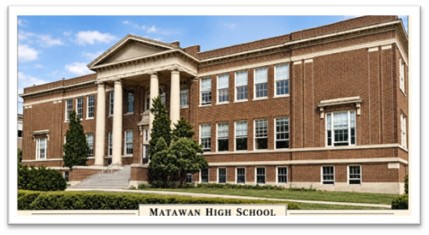 Ground was broken for the new Matawan High School on September 18, 1923. The new building was erected immediately adjacent to the older Graded School, preserving Broad Street as the center of public education while physically separating secondary education from the lower grades.
While the new building rose next door, students continued attending classes in the old school. Fortunately, by this period they were documenting their own experiences in the school publication, The Trialogue. Its surviving 1924 issues provide something largely absent from official Board minutes: the voices and everyday concerns of the students themselves.
Those pages reveal a remarkably recognizable high-school world. There were glee clubs and an orchestra, baseball, basketball and track, class officers, honor rolls, dances, a debating club, jokes about teachers and classmates, and the perennial senior preoccupation with examinations and graduation.
Debate, Athletics and School Spirit
One of the most celebrated events of the spring of 1924 was Matawan’s debating victory over Freehold High School. The subject was whether the United States should grant immediate independence to the Philippines. Matawan argued the negative before an enthusiastic audience in the High School auditorium. When the judges announced Matawan as the winner, The Trialogue described the auditorium erupting in cheers and school yells.
The students were particularly proud that the resulting debating trophy was destined for display in the new High School building.
Athletics had similarly become part of school identity. The 1924 record includes baseball contests against Freehold, Asbury Park, Leonardo, Red Bank, Keyport, Neptune and Perth Amboy, while graduating seniors received letters for participation in baseball, basketball and track.
The contrast with the tiny graduating classes at the beginning of the century is striking. Matawan High School was becoming not simply a course of study but a recognizable institution with its own organizations, rivalries and traditions.
The Senior Trip
Perhaps nothing brings these students to life more effectively than The Trialogue’s account of the 1924 senior trip to Washington, D.C.
Twenty-eight seniors and two chaperones left Matawan by train on May 8. Over several days they visited the Capitol while Congress was in session, the Library of Congress, Arlington National Cemetery, the White House, Corcoran Art Gallery, Mount Vernon, Washington Monument and Bureau of Engraving and Printing.
The student account is anything but a dry itinerary. One student tumbled on the Capitol steps; another worried that walking down the Washington Monument would make her appear so thin that her mother might think she was ill; students sang school songs on the boat returning from Mount Vernon; and the writer admitted that on their free evening in Washington, “few, if any, stayed in the hotel.” The account ends simply with the students’ regret that the trip was over.
It is a small episode, but an illuminating one. By 1924 the Matawan High School experience extended far beyond textbooks and examinations.
Thirty-Four Graduates
The most dramatic measure of growth is the graduating class itself.
In 1900, Matawan High School had graduated three students. In 1909, there were seven. In 1917, there were nine.
The Class of 1924 numbered thirty-four.
Their commencement exercises were held on Friday, June 13 – an ominous date that The Trialogue joked had proved lucky for the seniors. The commencement theme was “True Americanism,” with student orations on law, citizenship and public responsibility. Congressman and Board of Education president Elmer H. Geran presented the diplomas.
The same issue recorded what the graduates intended to do next. Some planned to attend Rutgers, normal school, Drexel, law school, Rider and other institutions; others entered business or employment, while several remained undecided. It is an unusually valuable glimpse of what a Matawan public-school education could lead to by the 1920s.
The Graded School Becomes the Grammar School
The new High School was occupied on September 29, 1924. With that move, a nearly thirty-year chapter in Matawan educational history came to an end.
Since 1895, the Graded School had accommodated virtually the entire range of public education. Within its walls children could progress through the elementary and grammar grades and eventually into the High School program. After September 1924, secondary students had their own building.
The older building consequently assumed a more limited role and became known as the Matawan Grammar School. The familiar later description of the “High School and Grammar School” therefore refers to two neighboring buildings that had developed from what had originally been a single consolidated educational system.
The physical arrangement neatly reflected Matawan’s educational development: the older building represented the consolidation movement of 1895; the new building represented the emergence of secondary education as an institution in its own right.
From Consolidation to a Modern School System
The transformation between 1895 and 1924 was remarkable. Matawan had progressed from scattered district schools to an eight-room central Graded School; from a handful of students pursuing rudimentary secondary courses to an accredited four-year High School; and finally to separate Grammar and High School buildings standing side by side.
Yet the statistics tell only part of the story. The surviving records allow us to see the students themselves -writing essays on child labor and international affairs, singing in glee clubs, competing on athletic fields, debating Philippine independence, worrying about final examinations, dancing at the Junior-Senior reception and boarding the train at Matawan for their senior trip to Washington.
By 1924, Matawan had created more than a larger school system. It had created a recognizable high-school experience.
From the Broad Street High School to Regionalization
The opening of the separate Matawan High School in 1924 did not end the growth of public education in Matawan. Rather, it began another phase. The new building provided secondary students with a home of their own while the former Graded School next door became the Grammar School. During the following decades, both enrollment and the range of educational opportunities continued to increase.
By the mid-1930s, the change was already apparent. During the 1935–36 school year, Matawan High School enrolled 388 students taught by fourteen teachers, and the Class of 1936 contained 76 graduates, the largest graduating class in the school’s history to that point. Part of this increase resulted from the admission of students from Laurence Harbor.
The physical plant evolved with the curriculum. In 1941, an annex was added to the High School containing business-education classrooms, a library, sewing room, shop, corridor lockers, and boys’ locker and shower rooms. These were not simply additional classrooms. They reflected the widening purpose of secondary education, with vocational, commercial and practical instruction joining the traditional academic curriculum.
The War Years
World War II interrupted this period of educational growth in a deeply personal way. The young men who entered military service after Pearl Harbor included recent Matawan High School graduates whose names, photographs and school activities survive in yearbooks and local records. Some never returned.
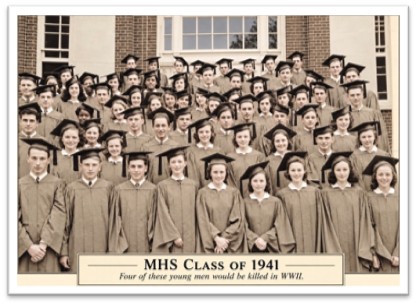 The Matawan Historical Society’s Wall of Honor preserves the stories of at least nine Matawan High School graduates who died while serving during World War II: Wilbur McElvaine, Class of 1933; Richard Louis Seidler, Class of 1935; William Frank Starkey Jr., Class of 1938; Arris Gordon Banke, Class of 1939; Richard “Dick” Emile Kostal, Class of 1940; and Raymond Charles Brown, Charles Joseph “Red” Kavanagh, George Thomas Durante and Spafford Walling Schanck Jr., all members of the Class of 1941.
Their school records remind us that these were students before they became names on a war memorial. Starkey had been an honor student and school spelling champion. Kavanagh lettered in football and track, played cornet and appeared in the senior play. Durante participated in the Shorthand and Reporters Clubs. Brown was an athlete.
Perhaps the most poignant connection belongs to Arris Gordon Banke. As a student in 1939, Banke composed the music for the Matawan High School Alma Mater. Four years later, while serving in the Navy, he disappeared with the crew of a training aircraft over the Gulf of Mexico. The music he helped give his school survived him.
The Class of 1941 was particularly hard hit. Four members of that single graduating class—Brown, Kavanagh, Durante and Schanck—appear on the Wall of Honor. Their deaths connect the larger history of World War II directly to the hallways and classrooms of Matawan High School.
The war therefore forms an important dividing line in the history of the schools. The students who returned entered a community that was itself about to change dramatically.
Postwar Growth
After World War II, Matawan’s educational problem changed in scale. Earlier generations had repeatedly enlarged individual schools as enrollment increased. Postwar residential development would eventually require something entirely different: a network of modern schools serving a rapidly suburbanizing community.
The process began before the great building boom of the 1960s. An addition to Cliffwood School opened in 1952. In 1955, Memorial School opened at the Broad Street-Church Street school site. Four years later, in 1959, a new Memorial School opened at Cliffwood.
These projects were signs of what was coming. The population of Matawan Township was increasingly dispersed beyond the traditional Borough center, and the old pattern in which Broad Street served as the natural focus of local education was becoming less practical.
The most dramatic change was still ahead.
Regionalization
In 1961, voters created the Matawan Regional School District, joining Matawan Borough and Matawan Township in a regional educational system. The change was one of the two great structural turning points in Matawan school history—the other having been the consolidation of the district schools in 1895.
The regional district was created by special election. Voters also determined that the costs of the district would be apportioned between the two municipalities according to average daily enrollment. That arrangement would later become controversial as population growth occurred unevenly between the Borough and Township.
Regionalization came at precisely the moment when the character of Matawan Township was changing.
In 1961, developer Levitt and Sons proposed the enormous Strathmore-at-Matawan development in the southeastern portion of the Township. Initial plans called for approximately 1,280 homes on nearly 500 acres, along with roads, utilities, recreational facilities, religious sites, shopping and other services. As part of the development, Levitt was required to provide land and a 34-classroom elementary school for the rapidly growing school population.
The scale of the project is difficult to overstate. Matawan was no longer simply accommodating gradual population growth. Entire neighborhoods were appearing within a few years.
Education had to grow with them.
A New Regional High School
The old Broad Street High School could not accommodate what was coming. A completely new Matawan Regional High School was constructed on Atlantic Avenue at a cost of approximately $2.5 million.
The contrast with the earlier schools was striking. The new building contained dozens of classrooms together with two gymnasiums, an auditorium, cafeteria, music rooms, industrial-arts shops, science laboratories and fine-arts rooms. It was designed not for the small-town high school of an earlier generation but for a large, comprehensive secondary-school program.
Even its opening demonstrated the pressures facing the district. Construction was not quite complete when the school year was scheduled to begin in September 1962, forcing officials to delay the opening by approximately two weeks and introduce students to the new building in groups. Nearly 1,200 students in grades seven through twelve would attend during its first year.
There was a certain poignancy to the transition. The 1962 yearbook, produced by the final graduating class at the old Broad Street building, acknowledged that the school had grown old and would soon be replaced by the new Atlantic Avenue school. The yearbook looked backward as well, illustrating both the original 1895 Graded School and the High School building that had served generations of students since the 1920s.
For students and alumni, Broad Street had been more than brick and mortar. It represented nearly four decades of school life. But once again, Matawan had outgrown its school.
Strathmore and the Suburban School System
The opening of the Regional High School did not solve the district’s space problem. It was only the beginning of a remarkable period of school construction.
Strathmore Elementary School opened in February 1963, serving the enormous new residential development that was transforming Matawan Township. Ravine Drive Elementary School followed in February 1966, and Lloyd Road Intermediate School opened in September 1967. Additions to the Broad Street and Ravine Drive schools opened in 1969. Finally, Matawan Avenue Middle School and Cambridge Park School opened in September 1970.
The speed of this construction makes sense only when viewed against the enrollment figures.
A 1966 Board of Education publication preserved in the MHS archive reported 6,055 pupils already attending eight school buildings. Enrollment was projected to reach 6,123 in 1966–67, 6,454 the following year, 7,078 by 1969–70 and 7,381 by 1970–71.
The Board consequently proposed still more construction: a 31-station intermediate school designed for 900 pupils and an 18-room primary school accommodating another 580, at a combined projected cost of $2.5 million.
The figures tell the story more effectively than almost any description could. In 1895, Matawan’s new Graded School had opened with 277 pupils. Seventy-one years later, the regional district was educating more than 6,000.
Growing Pains of Regionalization
Regionalization solved one problem while creating others.
Matawan Borough and Matawan Township shared a school system, but they were not growing at the same rate. New housing – particularly in the Township – shifted an increasing share of the district’s pupils outside the older Borough.
Because the regional district’s costs were initially apportioned according to average daily enrollment from the preceding year, rapid population changes created disputes over whether the formula accurately reflected the current distribution of students and costs.
The disagreement eventually reached the New Jersey Supreme Court in 1968 in Borough of Matawan v. Monmouth County Board of Taxation. The litigation provides unusually clear evidence of the strains created by rapid suburban growth. The Court’s account confirms both the 1961 creation of the regional district and the enrollment-based method originally selected by voters to divide its costs.
The controversy should not obscure the larger accomplishment. Within less than a decade, two municipalities had attempted to create an educational infrastructure capable of absorbing thousands of additional children while simultaneously expanding the curriculum and reorganizing students among elementary, intermediate, middle and high-school levels.
From Village Schools to a Regional System
By 1970, the transformation was essentially complete.
The educational landscape bore little resemblance to the Matawan of 1895. The old system had revolved around a single central Graded School. The postwar system consisted of multiple elementary schools, an intermediate school, a middle school and a large regional high school serving children from both Matawan Borough and Matawan Township. The archive’s chronology captures the pace of that change: Regional High School in 1962, Strathmore in 1963, Ravine Drive in 1966, Lloyd Road in 1967, additions in 1969, and Matawan Avenue and Cambridge Park in 1970.
The changes in the surrounding community were equally profound. Strathmore and other developments transformed former fields and less densely settled portions of Matawan Township into suburban neighborhoods. Schools followed the population.
There is an interesting symmetry in the history.
In 1895, Matawan responded to changing educational needs by abandoning the fragmented district-school model and bringing children together in a centralized Graded School.
In 1961, the community responded to another period of enormous change by moving in the opposite physical direction: a centralized system was no longer sufficient, and education had to spread outward into a network of schools serving a regional population.
Both transformations were responses to the same fundamental question: How should a community educate its children when the community itself has outgrown the system created by an earlier generation?
From the small schoolhouses of Middletown Point, through the academies and institutes of the nineteenth century, the Graded School of 1895, the High School of 1924 and finally the regional system of the postwar era, Matawan repeatedly answered that question by rebuilding its educational institutions to meet a changing community.
By 1970, the basic outlines of the modern school system were in place. The names, buildings and municipal boundaries would continue to change—Matawan Township itself would become Aberdeen Township in 1977—but the transformation from village schools to a regional educational system was complete.
Research note. This paper treats the MHS Digital Archive as the principal research collection. It draws on the “School” files synchronized to a research Drive, including local chronologies, school histories, district publications, private-school material, the Matawan Surname Project, Project 1850 and chronicler Pat Noble’s research notes; it also uses the 1936 Matawan anniversary material, the 1885 History of Monmouth County, and selected public historical sources for corroboration. The 140+ footnotes were omitted for “readability.” Aberdeen Historian Ed Fitzgerald’s remarkable past efforts are a major foundation for this paper. It’s important to note this was prepared with available information. Corrections and additions are welcomed – this is a living document. An AI agent acted as a research assistant in compiling most of and formatting some of the information presented (several items of which I would have never found without it), but I take responsibility for its content.
Mark Chidichimo
September 2026
NO COMMENTS