By Suzy Del Mage, Matawan Historical Society Researcher
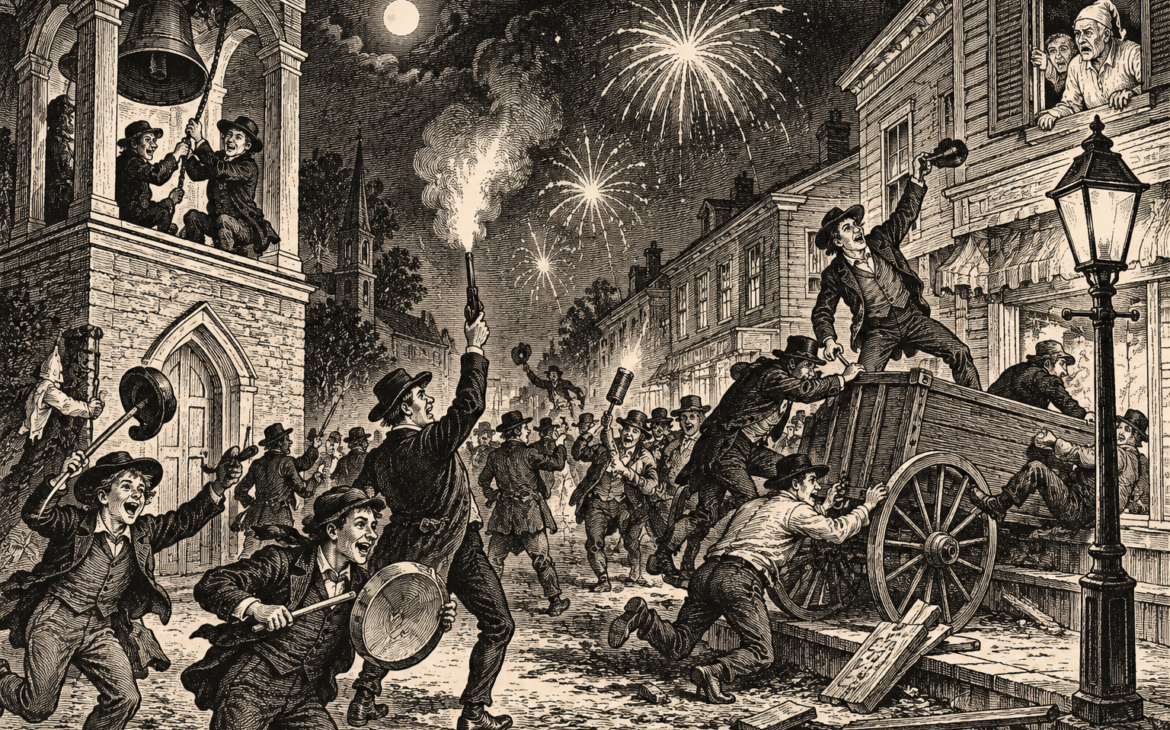
In the late 19th century, downtown Matawan observed the Fourth of July with vibrant patriotic displays, hanging American flags and bunting from storefronts while children innocently celebrated with small firecrackers. Beneath this civic pride, however, ran a deeper, rowdier tradition. For over thirty years, local young men marked the eves of New Year’s and Independence Day with midnight chaos—turning the quiet town upside down with raucous parties, improvised explosives, widespread property destruction, and illicit midnight demolitions.
Perhaps the most alarming of these holiday traditions was the unauthorized ringing of municipal and church bells. Following the founding of Washington Engine Company, Matawan’s first volunteer fire outfit in 1869, the town relied on an engine house bell as its primary emergency alarm. When revelers repeatedly broke into local belfries and firehouses at midnight, the sudden clamor panicked sleeping residents, who rushed downtown in the middle of the night expecting a destructive blaze. Separating holiday pranks from genuine emergencies was a constant challenge, especially as errant fireworks routinely sparked real fires across town.
The eve of Independence Day in 1875 opened with unusual calm, but the peace was short-lived. Midnight ushered in a wave of noise that lasted until dawn as local youths paraded through the streets, beating pans, discharging pistols, and continuously tolling the “old academy” bell. The relentless tolling pushed the town’s patience to its limit, prompting one local newspaper correspondent to dryly remark that exhausted residents “felt almost wicked enough to break the arm that was pulling the rope” of the bell.[1]
Over the next few years, the New Year’s and Fourth of July midnight celebrations were quieter and less disruptive,[2] until a coordinated effort of bell ringing occurred at midnight on July 4, 1878, accompanied by a boisterous group parading through the streets until dawn.[3] The Fourth of July in 1881 opened with bells ringing at the carriage factory and truck-house just after midnight, followed at dawn by gunfire and fireworks that awakened the sleepy town.[4]
As the Matawan residents finished celebrating New Year’s Eve in 1885, late-night mischief ensued downtown. About twenty people broke into the carriage factory at 136 Main Street and hosted a raucous party with two cases of Ballantine’s lager and were “holding high carnival” loudly playing violins, an accordion, and a banjo. Someone climbed to the building’s top floor to sound the carriage bell while another group simultaneously rang the truck-house alarms, sending startled residents rushing from their beds at the threat of fire. According to local accounts, a man of “rotund form” loudly ran into the factory and drove out the partygoers to protect his wagons and sleighs. Once the party broke up, the guest who supplied the lager sailed home with a case of lager under one arm and his fiddle under the other.
Meanwhile, two young men broke into the Presbyterian church and climbed a ladder into the belfry at 11:55 p.m. intending to ring the bell. However, a rival group of pranksters entered with a key, stole the belfry ladder, and stranded the duo in total darkness. Trapped in the tower, the boys struck match after match to locate a missing tall silk hat and search for an exit. Once the boys found a ladder and descended from the tower, they expected to find church elders ready to scold them; instead, they found the other pranksters waiting for them.[5]
Knowing that the local boys would keep the town awake all night on the Fourth of July in 1886, someone removed the fire bell ropes and prevented the annual raucous. To entertain themselves, the youths pursued quieter mischief—overturning stepping-stones and shifting street signs—until dawn, when they awakened the town with firecrackers and toy pistols. The holiday drew to a disgraceful close, marked by a riotous display of drunken young men filling the night with loud profanity. The evening culminated in violence when Edward Kelley followed Cornelius Matthews home, sparking a fight in which Edward was shot in the hand and tackled by Cornelius’s father, who stepped in to protect his son.[6]
The Fourth of July in 1889 proved exceptionally disruptive and lawless. Around 9 p.m. on July 3, C. E. Doddridge narrowly escaped injury when two consecutive bullets were fired through the window of his summer home at the Glenwood Institute. Doddridge saw two men flee up Church Street toward Main Street. Throughout the night, about twenty revelers moved wagons onto store porches, unhinged gates, piled boxes against storefront windows, shattered a streetlamp in front of the telegraph office with a firecracker, and launched fireworks until dawn.[7] Additional mayhem ensued outside the Matawan House hotel around 11 p.m. when locked doors barred entry to approximately thirty Irishmen from Marlboro and neighboring towns, who spent the night dancing on the porch and street to a hand organ.[8]
Matawan residents ushered in the New Year in 1892 at home much like a peaceful Sunday, with closed downtown stores and minimal travel on the streets. However, shortly before midnight the carriage factory bell rang and caused several downtown residents including Butcher Lisk and Marshal Van Brackle to quickly dress and inquire about the fire. They were informed that it was “New Years” and went home.[9]
Independence Day celebrations in 1892 and 1893 brought back-to-back years of familiar midnight chaos. On July 3, 1892, revelers launched fireworks, rang the engine house bell, and tolled the carriage factory bell for an hour until stopping “by sheer exhaustion,” while pranksters overturned stepping-stones, unhinged gates, and hauled wagons to “unheard of places.” Unfortunately, this dampened the spirits of those who had to clean up the mess the following day.[10] Matawan experienced a nearly identical disturbance in 1893, though the accompanying firework flashes reassured anxious residents that the tolling bells did not signal a fire.[11]
Independence Day mischief escalated to new heights in 1894 with intentional fires and a cannon explosion. Local youths continued their routine pranks—ringing church and fire bells, overturning stepping-stones, and unhinging gates—before setting fire to several of “Peterson’s oil barrels,” which luckily caused no harm. The mischief turned dangerous on Fountain Avenue when a stray firecracker landed on the chimney of Postmaster Clark’s rented house, sparking a roof fire. Around 2 p.m., a fire engine and hook-and-ladder crew arrived to extinguish the blaze, leaving about twenty-five dollars in water damage.[12]
Several revelers thought it amusing to discharge a “fair-sided cannon,” wheeling it directly in front of the old hotel property. They packed the barrel with roughly a pound of black powder, bricks, and loose debris. Once the fuse was lit, alert bystanders scattered just as built-up pressure caused the piece to explode like a bomb, showering the street with shrapnel and shattering a window at Clowes’ news depot.[13]
Holiday mischief was noticeably reduced in 1895. During New Year’s, town bells stayed quiet as local societies guarded their properties, though the pottery fire gong sounded several times. Dangerously, revelers ignited a street bonfire using Christmas trees around Peterson’s store.[14] On the Fourth of July, a daylong rainstorm limited shenanigans strictly to the eve of the holiday, when youth set off fireworks and rang the uptown fire alarm and Presbyterian Church bells for roughly fifteen minutes around midnight.[15]
After years of intruders sneaking into belfries, church officers took defensive measures for the Fourth of July in 1897. Sexton William Parker guarded the Presbyterian church bell and successfully prevented its ringing. At the M. E. Church, Sexton W. A. Holmes guarded the tower on July 2 and 3 but reportedly fell asleep around 11 p.m. Finding the church doors locked, a group broke a window, climbed into the belfry, and hauled the ladder up behind them so no one could stop their tolling. The pranksters rang the bell for an extended period, cut the bell rope in multiple places, and were reportedly so “foul-mouthed as to shock those nearby residents who were compelled to listen to it.” Lacking solid flooring in the belfry, one youth stepped through the plaster ceiling, sending debris crashing onto the pews below. The fallen debris scratched the pews and was tracked around the church. The group overturned stepping-stones, unhinged gates and outhouses, and attempted to tear up the wooden platform in front of the Bissell Block—until tenant Mrs. L. C. Herbert prevented the theft by repeatedly dousing them with buckets of water from above.[16]
Following the prior year’s destruction, Methodist Church officers—W. A. Fountain, G. B. Shepherd, F. C. Bedle, and F. Howard Lloyd—guarded their belfry throughout the eve of Independence Day in 1898 rather than hire outside watchmen. Local boys waited until past 4 a.m. for an opportunity to slip inside before finally giving up. The Presbyterian Church secured its building from the inside, leaving its bell undisturbed. Chief Scott spared the fire bell by directing the youths elsewhere, telling them they could “ring the carriage factory bell to their heart’s desire.” The resulting quiet was brief; starting at midnight, the carriage factory bell, the Truck House bell, and the fire gong sounded continuously for nearly four and a half hours. Mindful of prior years’ chaos, firefighters staged the steam-powered fire engine in front of the Engine House, fully prepared for any emergency.[17]
On the eve of the Fourth of July in 1899, local youth furiously rang only the Hook and Ladder bell. Revelers lit bonfires, executed pranks, and dropped a barrel down R. C. Smock’s well.[18] When a stray firecracker ignited Ten Eyck Conover’s roof, neighborhood children quickly reported the fire, allowing neighbor John Wilson to help douse the flames before major damage occurred.[19]
At the turn of the century, Matawan welcomed the year 1900 with a chorus of bells and steam whistles from the rice food factory, the terra cotta works, and the engines at the round house—though the rice food whistle had apparently been tampered with, making it scarcely audible uptown. The M.E. Church bell was also rung a few times to mark the occasion, but in a notable departure from past years, it was sounded by a church member rather than local youths.[20]
On the Fourth, the youth were unable to ring the town bells because the churches and fire departments were well guarded, leaving only the carriage factory and schoolhouse bells to briefly ring. Downtown Matawan narrowly avoided a major fire when a group of locals targeted a dilapidated, long-vacant structure just south of James Van Brackle’s cigar store, tearing it down to ignite a massive holiday bonfire. Nightwatchman Thompson discovered the destruction and intervened, preventing the crowd from setting ablaze the debris and saving the adjacent cigar store. In a surprising turn, property owner W. E. Arrowsmith expressed satisfaction with the unexpected demolition because he planned to dismantle the long-standing eyesore that day to salvage its timber for a chicken house. While local authorities condemned the illicit destruction, residents conceded that the sudden disappearance of the damaged building benefited the neighborhood.[21]
The next few years were much quieter in Matawan, with only sporadic bell ringing and the firing of pistols and fireworks on the eves of both holidays.[22] On the Fourth of July in 1901, several residents purchased two kegs of beer and left them on tap near the Little Street bridge for all to share. Unfortunately, several twelve-year-old boys indulged in the free alcohol, becoming heavily intoxicated and requiring assistance.[23] Midnight on New Year’s in 1905 brought only a brief twenty-minute barrage of gunfire and bell ringing. The familiar Rice Food factory whistle remained silent because there was no fire in the boilers.[24]
Perhaps the town’s youth finally tired of attempting to outwit church and firehouse guards, because late-night bell ringing on the eve of the Fourth of July ceased in 1906 for the first time in over three decades.[25] After more than thirty years of sleepless nights, false alarms, and damaged property, the late-night clamor that defined Matawan’s holiday eves came to a halt. As the persistent vigilance of townspeople and church trustees finally paid off, the wild midnight parades of banging pans, fireworks, exploding cannons, and stolen belfry ladders became relics of Matawan’s nineteenth-century past. Though exhausting for the residents and firefighters who endured them, these raucous historical accounts survive as a vivid window into the untamed spirit of 19th-century youth in Matawan, New Jersey.
SOURCES:
[1] “Celebration Exercises at Matawan,” Matawan (N.J.) Journal, 10 July 1875, p. 2, col. 2.
[2] “Matawan Journal [Dropping in],” Matawan (N.J.) Journal, 8 Jan. 1876, p. 2, col. 1. Also, “The Fourth of July,” Matawan (N.J.) Journal, 8 July 1876, p. 2, col. 2. Also, “Local Miscellany,” Matawan (N.J.) Journal, 7 July 1877, p. 2, col. 3.
[3] “The Fourth at Matawan!” Matawan (N.J.) Journal, 6 July 1878, p. 2, col. 2.
[4] “The Fourth at Matawan,” Matawan (N.J.) Journal, 9 July 1881, p. 2, col. 3.
[5] “Ringing in the New Year,” Matawan (N.J.) Journal, 3 Jan. 1885, p. 2, col. 3.
[6] “Fourth of July In Matawan,” Matawan (N.J.) Journal, 10 July 1886, p. 2, col. 3.
[7] “The Day Celebrated and Disgraced!,” Matawan (N.J.) Journal, 6 July 1887, p. 2, col. 1.
[8] “Made Night Hideous,” Matawan (N.J.) Journal, 6 July 1887, p. 2, col. 3.
[9] “Our Matawan Portfolio [How quiet it was],” Matawan (N.J.) Journal, 9 Jan. 1892, p. 3, cols. 1–2.
[10] “The Fourth in Matawan,” Matawan (N.J.) Journal, 9 July 1892, p. 2, col. 1.
[11] “The Glorious Fourth,” Matawan (N.J.) Journal, 8 July 1893, p. 1, col. 4.
[12] “A Small Fire on the Fourth,” Matawan (N.J.) Journal, 7 July 1894, p. 4, col. 3.
[13] “Matawan and Vicinity [There was the unusual],” Matawan (N.J.) Journal, 7 July 1894, p. 5, col. 1.
[14] “Matawan and Vicinity [The usual midnight],” Matawan (N.J.) Journal, 5 Jan. 1895, p. 5, col. 1.
[15] “Matawan and Vicinity [The Fourth of July],” Matawan (N.J.) Journal, 6 July 1895, p. 5, col. 1.
[16] “Ushering in the Fourth,” Matawan (N.J.) Journal, 8 July 1897, p. 1, col. 4.
[17] “The Fourth in Matawan,” Matawan (N.J.) Journal, 7 July 1898, p. 1, col. 1.
[18] “Matawan and Vicinity [The usual celebration],” Matawan (N.J.) Journal, 6 July 1899, p. 5, col. 1.
[19] “Matawan and Vicinity [A fire cracker],” Matawan (N.J.) Journal, 6 July 1899, p. 5, col. 1.
[20] “Ushering the New Year In,” Matawan (N.J.) Journal, 4 Jan. 1900, p. 1, col. 4.
[21] “The Fourth of July,” Matawan (N.J.) Journal, 5 July 1900, p. 1, col. 1.
[22] “Matawan and Vicinity [The Fourth of July],” Matawan (N.J.) Journal, 9 July 1903, p. 5, col. 1. Also, “A Quiet Fourth,” Matawan (N.J.) Journal, 7 July 1904, p. 1, col. 4. Also, “A Quiet Fourth,” Matawan (N.J.) Journal, 6 July 1905, p. 1, col. 3. Also, “Matawan and Vicinity [New Years],” Matawan (N.J.) Journal, 7 Jan. 1904, p. 5, col. 1.
[23] “Ushering in the Fourth,” Matawan (N.J.) Journal, 11 July 1901, p. 1, col. 5.
[24] “Matawan and Vicinity [New Years],” Matawan (N.J.) Journal, 7 Jan. 1905, p. 5, col. 1.
[25] “A Quiet Fourth,” Matawan (N.J.) Journal, 5 July 1906, p. 5, col. 1. Also, “The Fourth at Matawan!,” Matawan (N.J.) Journal, 6 July 1878, p. 2, col. 2.
NO COMMENTS