Growing Up on the Farm: Two Women’s Memories of Old Matawan Township
Living in Matawan for just 37 years, I have no memories of Route 34 going through Matawan and Aberdeen being anything other than strip malls, fast food restaurants and banks. It’s hard for me to imagine that long before businesses and housing developments transformed the countryside surrounding Matawan, much of what is now Aberdeen Township was farmland. Fields, orchards, barns, livestock, and farm wagons were familiar features of the landscape. Two women who grew up in this agricultural community left particularly valuable recollections of what life was like before much of that landscape disappeared.
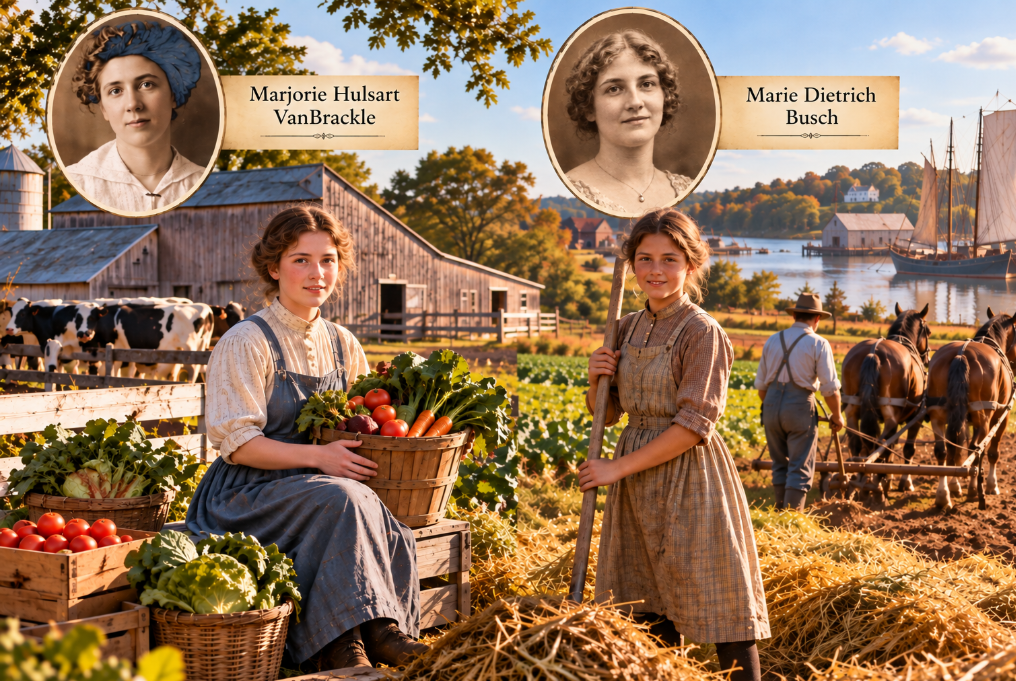
Marjorie Hulsart VanBrackle (1891–1985) grew up on her family’s farm along Holmdel Road, now Route 34, near the present-day Park Place Diner. Her father, Charles C. Hulsart, was an unusually progressive farmer who worked with the agricultural college in New Brunswick and embraced new methods and conveniences. Marjorie remembered the family’s greenhouse, the introduction of indoor plumbing and central heating, and her father’s early purchase of an automobile. Marjorie is the 2nd cousin, twice removed of MHS member Richie Hulsart.
Her memories also capture the pleasures and hardships of country childhood. She recalled sleigh rides through snowy Matawan streets, the excitement of farm animals arriving by railroad, and the difficulty of adjusting to school after growing up in the countryside. Her account is not entirely nostalgic: it also records devastating family losses, harsh winters, and the uncertainties of rural life.
Of particular interest to Matawan’s maritime history is Marjorie’s recollection of the produce boats that traveled up Matawan Creek. Farmers brought their harvests to the waterfront, where their goods were loaded for shipment to New York. Her memories remind us that agriculture and maritime commerce were closely connected. Her recollections are recorded here: ( https://matawanhistoricalsociety.org/memories-of-marjorie-hulsart-vanbrackle/ )
Marie Dietrich Busch (1905–2002) grew up on her family’s farm in Matawan Township, near Lloyd Road and Church Street. Interviewed in 2000 at the age of 94, Marie described an agricultural world in which nearly everything depended upon horses and human labor.
The Dietrich family cultivated substantial acreage, growing vegetables and corn while raising cows, pigs, chickens, and horses. Marie remembered working in the fields with her father and brother, often until darkness. She described milking cows, preparing planting beds with manure, storing corn for winter feed, and using horses to cultivate the land before tractors became commonplace.
Her recollections are especially revealing about the contributions of women to farm life. Marie remembered her mother working long hours in the fields before returning home to prepare supper and attend to the household. Seeing her mother’s exhaustion, young Marie taught herself to milk the cows to relieve some of that burden.
Marie also recalled the family’s old gristmill, the children who spent summers on the farm, and the social distinctions between residents of Matawan Borough and the surrounding township. Her account extends into the twentieth century, when mechanization and suburban development gradually transformed the countryside. By the early 1960s, much of the family’s former farmland had been sold for development. Her story is detailed here: Marie Dietrich Busch interview
Although Marjorie and Marie came from different families and described somewhat different experiences, their recollections complement one another. Marjorie’s memories emphasize the family, social life, and changing conveniences of a prosperous agricultural household. Marie’s account provides a particularly vivid description of the physical labor, resourcefulness, and responsibilities that sustained a working farm.
Together, their stories remind us that the history of Matawan and Aberdeen is not simply the history of buildings, roads, and businesses. It is also the history of the people who worked the land, raised families, and supplied food to their neighbors and distant markets.
Fortunately, both women’s accounts have been preserved. We encourage members to explore them in their entirety. They offer something that maps, census records, and newspaper advertisements cannot: the voices of people who remembered the agricultural landscape firsthand.
Both women are buried in the Old Tennent Churchyard, Tennent, NJ.
(Author’s note: the photo of Marjorie is accurate. Marie’s image, however, was rendered from a poor original and may not be a good likeness.)
— Mark Chidichimo
NO COMMENTS