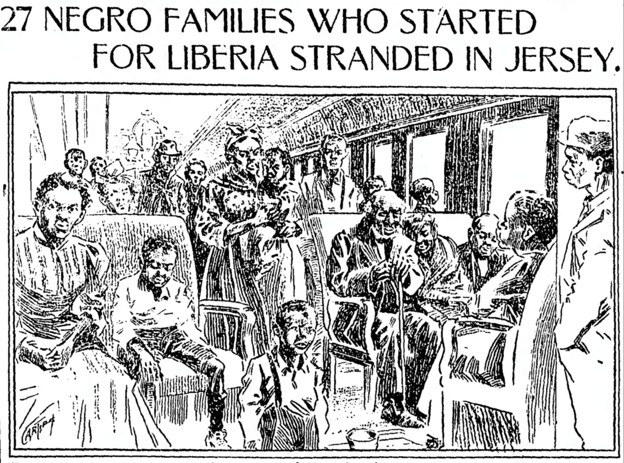
In the late 19th century, Black families were looking to escape the persecution and violence of the post-Reconstruction South. Bishop Henry McNeal Turner of the African Methodist Episcopal (AME) Church promoted a Back-to-Africa movement, seeing migration as a viable approach to peace and prosperity for Black families. But his movement was unable to cope with the large number of interested parties, so more commercial and less savory groups filled the gap and began taking advantage of Black families. They sold subscriptions and bilked many participants of their savings and hopes. Those who did make it to Liberia faced cultural clashes and tropical diseases they did not anticipate.
INTERNATIONAL MIGRATION SOCIETY
An agent of the much-maligned International Migration Society (Society), Birmingham, Alabama, recruited 40 Black families from Kingfisher and Logan counties, Oklahoma for an opportunity to relocate to Monrovia, Liberia. The families sold their farms quickly and at an unfavorable price. Farms of either 80 or 160 acres in size and valued up to $2,000 each (including livestock and buildings) went for as little as $400. Tickets were selling at the rate of $32 per person for those over 12 years old and half that price for children over 3 years old, so some sold to raise the cash while others paid by subscription.
The Oklahomans became impatient to leave, so they telegraphed the Society that they would soon set off for New York. The Society reportedly urged the prospective migrants to wait for better conditions in Liberia. When they got to the train station, 13 families did not have money for the train tickets to New York, so only 27 families, totaling 104 persons, set off for New York.
Edward B Cottingham, Secretary of the International Migration Society based in Birmingham, Alabama, initially denied any involvement with the stranded migrants. He claimed that his organization always uses Savannah, Georgia and other southern ports for such departures. Cottingham said a sailing was being organized for Savannah, not New York. Cottingham spoke on 17 March on behalf of the society’s president, Daniel J Flummer, who was at his home in Birmingham at the time. The Birmingham Post Herald noted that the Society had had difficulty procuring ships for this purpose on several occasions, leaving parties waiting a long time for a ship.
A week later, Cottingham gave a fuller explanation, stating that the Society had a recruiter in Oklahoma, but several of the participants had not yet paid for their passage and the required number of participants had not yet been reached. When the Society’s recruiter advised the Society that the Oklahomans would soon be leaving for the ship, Cottingham sent word that they should not do so. The Society reasserted its lack of obligation to the travelers, who didn’t attend to the required elements of the plan.
SOUTHERN DISTRICT OF NEW YORK
Rev W G Hawes and his brother, Sam Hawes, filed a grievance on the migrants’ behalf with US Commissioner for the Southern District of New York John A Shields, seeking action against the Society. Shields told them that the Society may have committed mail fraud and referred them to US Postal Inspectors. The Hawes brothers had copies of correspondence with the Society, including a letter urging the group to delay departure until 1,500 persons were ready to travel.
The Hawes brothers said passage was discussed with Daniel Bacon and Company, agents of the British and African Steam Navigation Company. Bacon telegraphed the Society, who refused to assume any financial obligations of the group.
JERSEY CITY
In the meantime, the Oklahomans were living in two railroad cars provided by Central Jersey Railroad officials at Communipaw, New Jersey, outside of Jersey City. The railroad provided heat and lighting but no food or other necessities. Some of the migrants were relying on local charities for food. The Jersey City Chief of Police was taking steps to have them move on, claiming that the city was becoming “a dumping ground for everything and everybody”.
CLIFFWOOD BRICK COMPANY
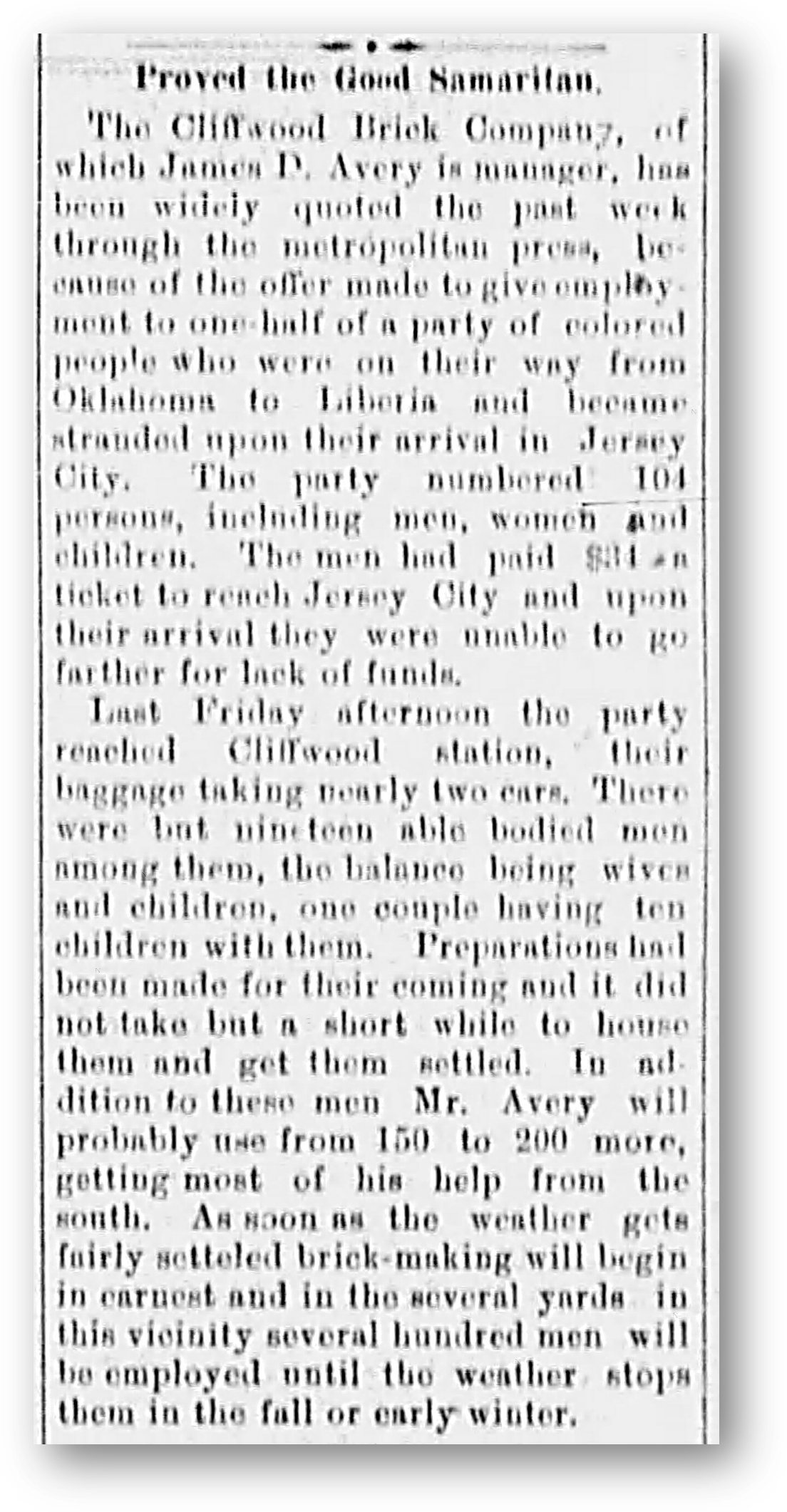 The migrant group received a telegram from James D Avery, of the Cliffwood Brick Company, of Cliffwood, New Jersey, offering them housing and work for the able-bodied men among them. They accepted the offer, happy to be rescued from their situation but disappointed that their dream of resettling in Liberia had been dashed.
The group arrived at Cliffwood Station on 24 March 1899 with nearly two railroad cars full of their belongings. There were only nineteen able-bodied men, the rest wives and children, one family with ten children. The company had prepared for their arrival, so the families were quickly housed.
The Matawan Journal noted the wide press coverage of the past month and how Avery had become something of a Good Samaritan. The newspaper said Avery would be hiring 150 to 200 more men for his brickyard, recruiting mostly from the South. The multiple yards in the Matawan area would begin operations soon, after a winter break, and the men would be employed until the fall or early winter.
It’s important to realize that the brick company straddled Whale Creek, which forms the border of Monmouth and Middlesex counties. At the time, the many brickworks in the area were in Matawan Township (now Aberdeen), Matawan Borough, and Madison Township (now Old Bridge). (Note: Cliffwood Beach, which also had a brickyard, likewise straddles Whale Creek, but those communities were not formed until the 1920s.)
The 1900 US Census listed James D Avery and family living in Madison Township. On the same and following pages were over 150 Black brickyard workers born in Virginia and North Carolina (see Appendix A for a list of Black brickyard workers.). They would surely be Cliffwood Brick Company workers and include up to 19 members of the migrant group.
Much more research is required on this interesting topic.
Pat Noble
APPENDIX A – Black Brickyard Laborers in the 1900 US Census, Madison, NJ
Below is a list of Black employees of Cliffwood Brick Company as enumerated in Madison Township, Middlesex County, New Jersey in the 1900 US Census. Most of the men were listed as a “Partner” employed at a brickyard. The names were in large clusters and followed the entry of James Denton Avery (1861-1927) and his family. Avery was listed as Brick Manufacturer. Note that Avery made occasional trips to the South to recruit workers, so some of these men are very likely recruits and not from the Oklahoma group.
- Charles Daniel (Abt 1868 VA)
- Jennings Mosely (Apr 1874 VA)
- Charles Mosely
- Emanuel Motley (Aug 1857, NC)
- William Newsman (Abt 1874, NC)
- William Joiner (Nov 1870, NC)
- Thomas S Lea (Abt 1873, VA)
- Joseph T Porter (Jul 1878, VA)
- Jacob Serrell (Jul 1875, NC)
- George Parker (Feb 1883, VA)
- Solomon Irving (Dec 1880, VA)
- Samuel Turner (Abt 1882, VA)
- John Turner (Oct 1878, VA)
- Clarence Taylor (Mar 1877, VA)
- Albert Shelley (Sep 1879, VA)
- James Smith (Sep 1876, VA)
- Peter Schugero (Apr 1872, VA)
- James Henry Peoples (Nov 1875, NC)
- Charles Blow Abt 1848, VA)
- Edward Blow (Mar 1879, VA)
- Norman Walker Abt 1881, VA)
- Samuel Hill (Apr 1876 VA)
- Albert Hayes (Feb 1876 VA)
- Jerry Mosley (Jun 1873 VA)
- Walter Mosley (Abt 1881 VA)
- Elisha Mosley (Apr 1874 VA)
- Jacob Haskins (Dec 1884 VA)
- Charles Clark (Oct 1880 VA)
- Grand Smith (Sep 1879 VA)
- Elisha Elliott (Abt 1881 VA)
- Henry Brooks (May 1882 VA)
- George Gregory (Apr 1882 VA)
- John Clark (Abt 1883 VA)
- John Moden (Apr 1883 VA)
- Joridan Bruce (Mar 1884 VA)
- Paul Lea (May 1878 VA)
- Max Skipper (Feb 1881 VA)
- John Richardson (Abt 1883 VA)
- John Mosley (Abt 1884 VA)
- Albert Haskins (Abt 1882 VA)
- Robert Ferell (Abt 1882 VA)
- Gay Bethel (Abt 1877 VA)
- George Harvey (Aug 1876 VA)
- Thomas Lea (Nov 1882 NC)
- Albert Lather (May 1870 NC)
- Henry Copley (Apr 1882 VA)
- Robert Lea Brown (Oct 1877 VA)
- William Brown Abt 1876 VA)
- Jacob Johnson (Apr 1879 VA)
- Marshall Wildridge (Abt 1878 VA)
- Malachi Jackson Abt 1876 VA)
- Andrew Dennis (Jan 1879 NC)
- Henry Johnson (Abt 1876 VA)
- Henry Randolf (Sep 1881 VA)
- John Brown (Abt 1874 VA)
- Littleton Jones (Abt 1878 VA)
- Littleton Jefferson (Abt 1876 VA)
- William Elam) Abt 1840 VA)
- Jesse Haskins (Sep 1864 VA)
- William Jefferies (Abt 1874 VA)
- William Evans (Abt 1875 DC)
- Edward Toliver (Abt 1875 VA)
- Joseph Carter (Abt 1878 VA)
- Joseph Williamson (Abt 1855 VA)
- Walter Brown (Nov 1876 VA)
- Robert Stafford (Apr 1878 DE)
- Henry Dannels (Abt 1878 VA)
- Gus Coles (Jun 1874 VA)
- Richard Braswell (Jun 1877 NC)
- Forest Braswell (Apr 1880 NC)
- Samuel Whitaker (Jun 1877 NC)
- Julius Ray (Jan 1881 NC)
- Walter Torran (Abt 1881 NC)
- Edward Arens (Abt 1878 NC)
- Mark Lyons (Sep 1879 NC)
- Allen Bryant (Apr 1878 NC)
- Daniel Jackson (Mar 1873 VA)
- Giles Richards (Jun 1880 VA)
- Otis Groves (Nov 1881 VA)
- Buck Clark (Jul 1870 VA)
- Charles Logan (Dec 1882 VA)
- James Booze (Abt 1882 NC)
- Rufus Conrad (Mar 1877 NC)
- Abraham Conrad (Aug 1878 NC)
- James Ellington (Abt 1876 NC)
- William Lash (Abt 1877 NC)
- Otto Peoples (May 1872 NC)
- Robert Miller (May 1872 NC)
- Eugene Steward (Abt 1877 NC)
- John Gardner (Apr 1878 NC)
- Isack Allen (Feb 1876 NC)
- William Martain (May 1874 NC)
- John Wilkinson (Sep 1880 NC)
- William Stokes (Abt 1876 VA)
- James Knight (Abt 1877 VA)
- Henry Hart (Abt 1867 VA)
- Edward Perry (May 1870 VA)
- Albert Grabbs (Aug 1878 NC)
- Clarence Merrill (Nov 1875 NC)
- Walter Gee (Apr 1878 VA)
- Thomas Felton (Mar 1858 NC)
- Moses Droomgole (Dec 1873 VA)
- William Droomgole (Apr 1878 VA)
- William Durham (Abt 187 NC)
- Austin Marshall (Aug 1854 NC)
- Ernest Minor (Abt 1872 NC)
- Louis Miller (Oct 1873 VA)
- Felix Miller Jun 1873 VA)
- James Miller (Oct 1875 VA)
- Thomas Bell (Jul 1879 VA)
- John Gallian (Aug 1861 VA)
- Robert Stalks (Abt 1853 VA)
- Joseph Brown (Abt 1878 VA)
- Frank Morton (Nov 1874 VA)
- Joseph Morton (Abt 1879 VA)
- James Morton (Feb 1882 VA)
- Jasper Freeman (May 1879 NC)
- Joseph Knight (Aug 1883 VA)
- John Ross (Jul 1875 VA)
- Macon Bagley (Abt 1880 VA)
- Isack Brown (Jun 1862 VA)
- David Bagley (Apr 1878 VA)
- Thomas Evans (Mar 1878 VA)
- Asa Taylor (Dec 1879 VA)
- Isham Smith (Oct 1880 VA)
- Braxton Clark (Dec 1875 VA)
- Albert Roe (Dec 1875 VA)
- John Fowlks (Feb 1874 VA)
- Henry McAlister (Abt 1877 VA)
- Joshua Doswell (Dec 1879 VA)
- Henry Mosley (Dec 1880 VA)
- Gus Clark (Jun 1883 VA)
- Henry Harris (Oct 1879 VA)
APPENDIX B – Black Brickyard Laborers in the 1900 US Census, Matawan, NJ
There is a much shorter list of Black brickyard laborers living in Matawan in the 1900 US Census. Some had children who were born in New Jersey prior to March 1899.
- Edward Anderson (Sep 1880, VA) (Atlantic Ave)
- James Conway (May 1868, VA) (Atlantic Ave) (children born in NJ before 1899)
- Henry Hamm (Apr 1862, NC) (Atlantic Ave)
- Arthur Hills (Aug 1876, NC) (Atlantic Ave)
- Alfred Terry (Apr 1864, VA) (Atlantic Ave) (child born in NJ in Sep 1898)
- Nelson White (abt 1865 VA) (Atlantic Ave) (child born in NJ in Feb 1899)
SOURCES
- Colonists Gather for Liberia Journey (7 Mar 1899, The Guthrie Daily Leader)
- Group Leaves Oka Territory By Train (9 Mar 1899, Trenton Daily Times)
- Cottingham Denies Responsibility (17 Mar 1899, Birmingham Post Herald)
- Encampment in Jersey City (22 Mar 1899, The Jersey City News)
- Group Enroute to Liberia (23 Mar 1899, South McAlister Capital)
- Stranded Colonists (23 Mar 1899, The World)
- Telegram From Matawan Offers Jobs, Homes (24 Mar 1899, The New York Sun)
- Negro Emigrants in a Sad Plight (24 Mar 1899, Birmingham Post Herald)
- Stranded in New Jersey (25 Mar 1899, Daily Enterprise Times)
- Group Conned by Hawes (25 Mar 1899, The Daily Chieftain)
- Found a Haven in New Jersey (25 Mar 1899, Birmingham Post Herald)
- Defrauded and Deserted (30 Mar 1899, The Kingfisher Times)
- Men Promised Work and Homes (30 Mar 1899, The Shore Press)
- Proved the Good Samaritan (30 Mar 1899, Matawan Journal)
- Black Migrants to Brick Company (31 Mar 1899, Plainville Gazette)
NO COMMENTS