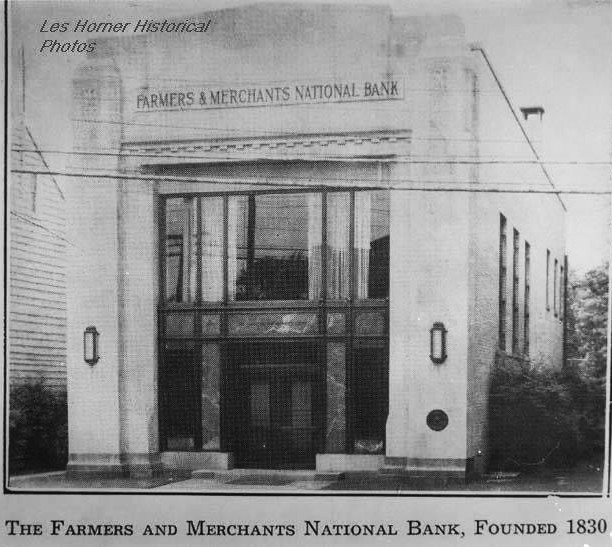
The First Bank of Monmouth County, 1830–1902
by Linda Hinger, Matawan Historical Society Researcher
Part 1. Bank History
In the early decades of the nineteenth century, the village of Middletown Point—the community now known as Matawan—was a thriving riverside trading port on the route between New Jersey’s farming interior and the markets of New York City. Sailing sloops loaded with produce, lumber, and goods departed from docks along what is now Lake Lefferts, then an open estuary feeding into Raritan Bay. The community supported potash mills, brickyards, grist mills, warehouses, and a growing merchant class. Yet for all this activity, residents lacked a fundamental piece of economic infrastructure: a local bank.
Before 1830, the nearest reliable bank was three days away by water. Farmers paid in foodstuffs or barter; merchants accepted bank notes of uncertain value, often issued by distant institutions whose specie reserves could not be readily verified. To keep money safely required either entrusting it to a New York banker or risking robbery on the long ride home with metal coin in hand. As the regional economy grew, this began to limit the community’s prosperity.
Two Founders, One Vision
Two men changed this. D. Lafayette Schenck—a farmer reputed to have been the first American child named in honor of the Marquis de Lafayette—and William Little, a merchant who had operated an extensive store at Middletown Point since at least 1815, recognized that the community had grown beyond what informal credit could support. Together they petitioned the New Jersey legislature for a charter.
According to a 1911 historical address by Henry C. Winsor, drawn from records prepared by then-cashier Charles H. Wardell, the charter was issued on February 3, 1830. Securing it was not simple. The petition was advertised in newspapers in Freehold, New Brunswick, and Trenton to allow public objection. According to a long-held institutional account, William Little drove a team of horses overnight through a February snowstorm to reach Trenton in time to see Governor Peter D. Vroom and push the petition through the assembly before the legislature adjourned.
Charter, Capital, and Operations
The charter authorized $50,000 in capital stock. Subscriptions had to be collected by a state-appointed commission, and once raised, the legislature had to sanction a meeting of officers and directors. That meeting took place on March 21, 1831—more than a year after the charter was issued—at the home of David Antonides. A second meeting in April was held at the home of Ellen Wares. Mr. Schenck was elected president; Mr. Little was named head of the board of directors and the bank’s first cashier, a role he held only briefly before Elihu Baker succeeded him in April 1832. Mr. Little later returned to the bank as president, succeeding Schenck.
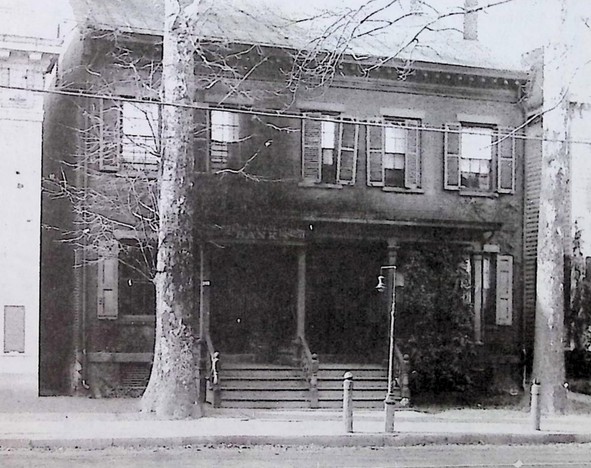
First Bank Building
The directors were sworn in on June 13, 1831, by Samuel C. Vanderhoef, a justice of the New Jersey Supreme Court. Sixteen months after the charter was granted, the Farmers’ and Merchants’ Bank of Middletown Point opened for business in William Little’s store at 143 Main Street—known historically as the Gehlhaus block. An iron keg served as the original safe. In 1836, a brick bank building was erected at 146 Main Street at a cost of $3,400, contracted with Francis P. Simpson’s newly established lumber yard.
The first dividend, four percent for the prior six-month period, was declared in July 1832, and dividends were paid without interruption for the remainder of the bank’s independent existence.
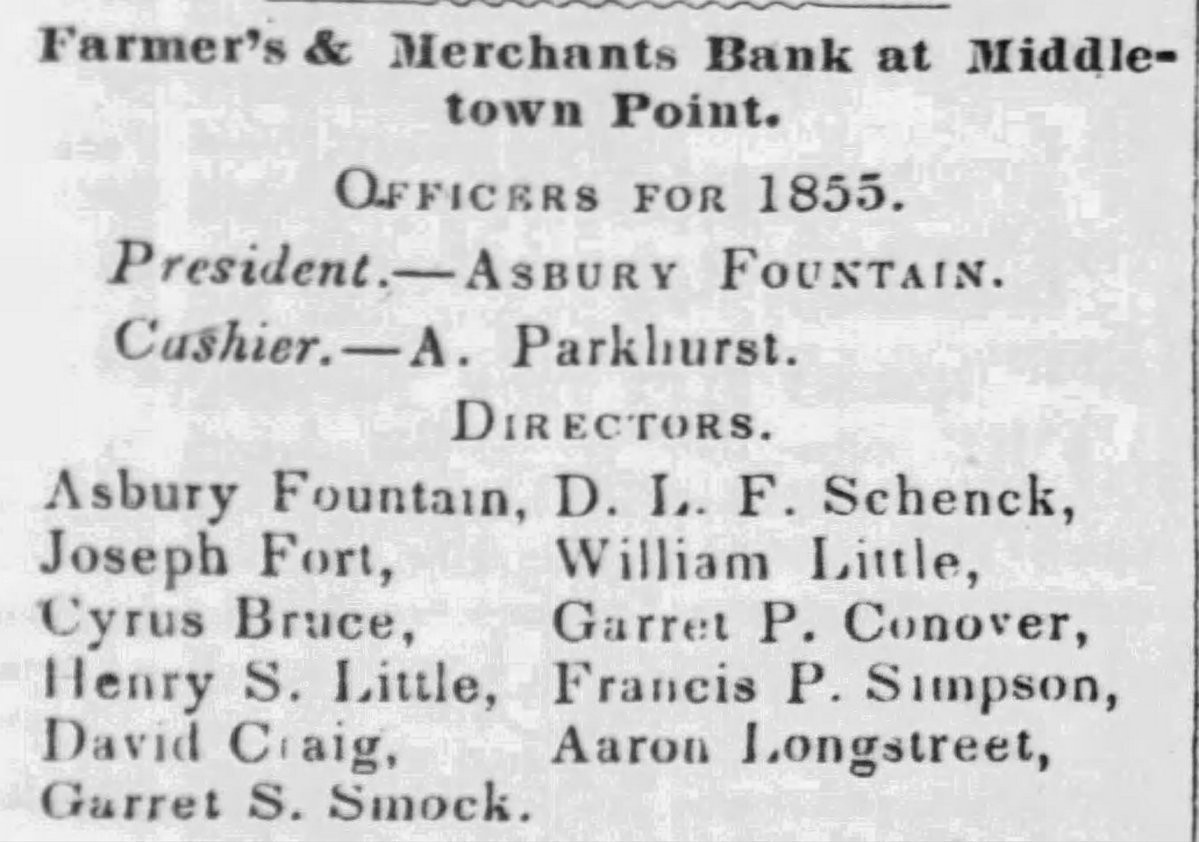
By 1855, leadership had passed to a new generation: Asbury Fountain served as president and A. Parkhurst as cashier. Listed in the Monmouth Democrat, January 11, 1855.
A Citadel of Honesty in Difficult Times
The bank operated during a period of financial volatility. The Panic of 1837 collapsed banks across the country; New Jersey’s Monmouth Bank, established in Freehold in 1824, had already failed in 1836. The Farmers’ and Merchants’ Bank, in contrast, met every demand for redemption. In the same year, it raised its cashier’s salary and extended credit to local merchants for the purchase of the steamboat Monmouth, which reduced travel time to New York from three days by sail to one. The bank later bid in the steamboat at sheriff’s sale to protect both its loan and the community’s vital transportation link.
Throughout the panics of 1857, 1873, and 1893, the bank continued to operate without disruption. The bank’s 1957 anniversary history described it as “a citadel of honesty in a time of fraud and sharp practice.”
From Middletown Point to Matawan
In 1865, William Little—by then president of the bank and a New Jersey state senator—sponsored a referendum to change the village’s name from Middletown Point to Matawan. The institution’s name was updated accordingly to the Farmers’ and Merchants’ Bank of Matawan, though its charter and continuity remained unbroken.
On October 9, 1902, the directors converted the institution to a national charter. The state-chartered Farmers’ and Merchants’ Bank, after seventy-two years of continuous operation, was dissolved, and its assets and liabilities were assumed by the new Farmers’ and Merchants’ National Bank of Matawan. On November 4, 1914, the bank opened its modern banking house at the corner of Main Street and Ravine Drive—the first of its kind in northern Monmouth County.
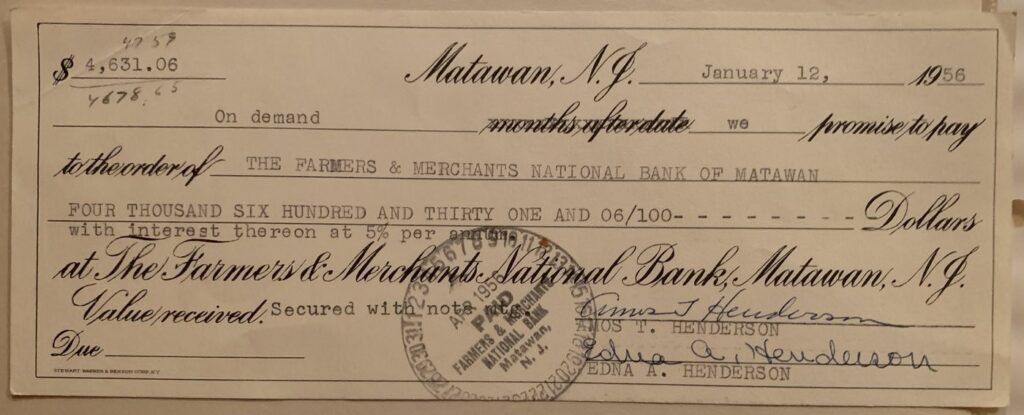 A promissory note payable to the Farmers’ & Merchants’ National Bank of Matawan, dated January 12, 1956 — a glimpse of the bank in its later years.
Legacy
Through the late nineteenth and twentieth centuries, men trained at the Farmers’ and Merchants’ Bank went on to found and lead banks across Monmouth and Middlesex counties—institutions in Red Bank, Freehold, Long Branch, Asbury Park, Manasquan, Spring Lake, Keyport, Rahway, and South River, among others. The bank itself was eventually consolidated through a series of mergers, becoming part of Franklin State Bank in 1971, United Jersey Bank in 1988, and Summit Bank by the late 1990s.
Today, the founding of this bank stands as a turning point in the economic history of Monmouth County—a moment when local ambition, patient capital, and community trust came together to build something lasting. As visitors stand within the Burrowes Mansion, they are reminded that the heritage preserved here extends well beyond these walls, embracing the institutions and enterprises that shaped the wider community.
Sources
Matawan Journal, May 11, 1911 (Henry C. Winsor historical address); Matawan Journal, May 12, 1955 commemorative history; Monmouth Democrat, January 11, 1855; The Farmers & Merchants National Bank brochure (1957); 1997 Matawan-Aberdeen Hometown Shopper history; Matawan Historical Society institutional records.
Part 2. The Bank FoUNDERS
D. Lafayette Schenck and William Little
The Farmers’ and Merchants’ Bank of Middletown Point owes its existence to two very different men whose lives, by 1830, had brought them to the same conclusion: their growing community needed a bank of its own. One was a farmer with deep roots in Monmouth County’s soil. The other was a merchant, recently arrived from Ireland, who had built a thriving business at the heart of the village. Together, they founded an institution that would outlast them by more than a century.
D. Lafayette Schenck (President, 1831–mid-1830s)
D. Lafayette Schenck was born during the Revolutionary War. Historical accounts indicate he is reputed to have been the first American child named in honor of the Marquis de Lafayette, the French nobleman whose military aid had proven decisive to the American cause. The name was a statement of patriotism by the Schenck family, and a signal of the era’s deep gratitude toward its French allies.
Schenck entered the tanning and currying business in Matawan as a young man, while also operating a farm. He was a moving spirit in transportation improvement, working to convert the then nearly impassable road to Freehold into a plank-and-gravel turnpike. As his agricultural ventures prospered, he gradually shifted his attention from local commerce toward larger-scale farming. In 1830—the same year he and William Little petitioned the legislature for a bank charter—Schenck made the decision to concentrate his operations in Holmdel, on a scale considered very large for the period.
When the Farmers’ and Merchants’ Bank held its first meeting of officers and directors on March 21, 1831, Schenck was elected its first president, a post he held until the mid-1830s. He continued to serve the bank in critical moments thereafter. In 1839, when a steamboat venture financed by the bank ran into difficulty, it was Schenck who personally bid in the steamer Monmouth at a sheriff’s sale in New York, satisfying the creditors and ensuring that both the bank’s loan and the community’s vital transportation link were preserved. He continued to serve the institution in various capacities into the 1850s.
William Little (Cashier 1831–1832; later President)
William Little came to America from Ireland in 1810. By 1815, he had established himself as a merchant at Middletown Point, operating a store at the corner opposite the First Methodist Church—a building constructed in 1800 by Colonel James Conover and purchased by Little from its second proprietary owner, John Quay. He also acquired an interest in the navigation company that operated sailing sloops between Middletown Point and New York, giving him direct knowledge of the trade routes that defined the local economy.
It was Little, more than anyone else, who drove the bank into existence. According to a long-held institutional account, when the petition for the charter encountered a procedural delay in Trenton, Little drove a team of horses overnight through a February snowstorm to reach the capital. There he secured an audience with Governor Peter D. Vroom and pressed the petition through the assembly before the legislature adjourned. The bank’s attorney, William Dayton, had studied law under Vroom before his rise to the governorship, which gave Little a ready approach to the executive branch of the state government.
When the bank opened on June 13, 1831, Little served as its first cashier—a role he had to take initially without an agreed salary. His tenure as cashier was short; in April 1832, Elihu Baker succeeded him. The directors voted Little $500 for his year of service in organizing the bank. A few years later, Little succeeded Schenck as president, a post he held until 1843, when William Herbert took over and served until Asbury Fountain began his long tenure in 1847.
Little’s influence extended far beyond banking. As a Democratic state senator representing Monmouth County, he sponsored the 1865 referendum that changed the village’s name from Middletown Point to Matawan. He later helped secure the railroad charters and bridge financing that connected the New Jersey shore to the regional rail network. The bank’s attorney, William Dayton, would go on to a distinguished career as a U.S. senator, the first Republican vice-presidential nominee in 1856, and ambassador to France during the Civil War.
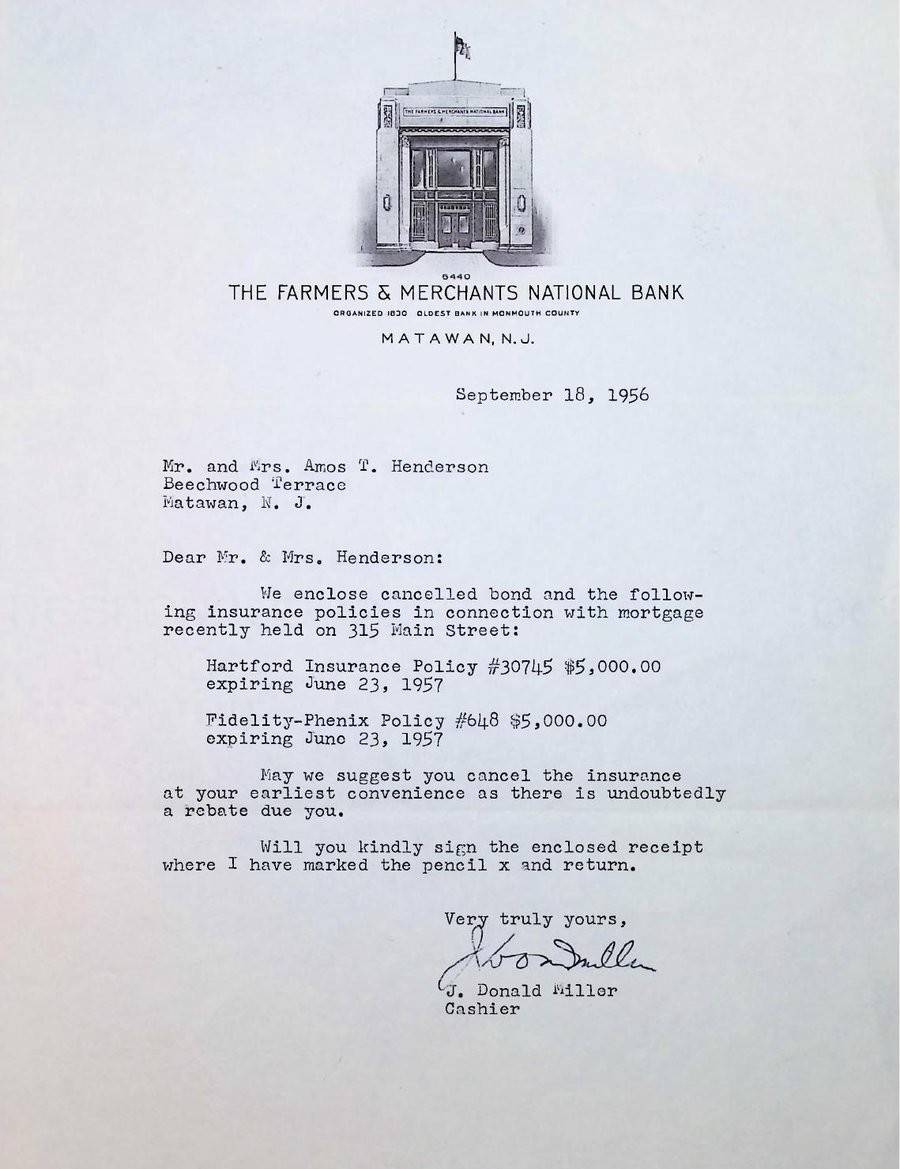 The bank’s official letterhead, dated 1956, declaring it “Organized 1830 — Oldest Bank in Monmouth County.” The institution Schenck and Little founded operated under variations of this same name for 141 years.
A Lasting Partnership
The combination of Schenck’s standing among the county’s farmers and Little’s connections among its merchants and political leaders gave the new institution credibility in both directions. The bank they founded weathered the panics of 1837, 1857, 1873, and 1893—often when neighboring institutions did not. It eventually trained a generation of bankers who founded financial institutions across Monmouth and Middlesex counties and beyond.
Their two names—the farmer’s and the merchant’s—are preserved in the bank’s very title: the Farmers’ and Merchants’ Bank. It was a fitting acknowledgment of the partnership that brought it into being, and of the two communities, agricultural and commercial, that the bank was created to serve.
Sources
Matawan Journal, May 11, 1911 (Winsor address); Matawan Journal, May 12, 1955 commemorative history; The Farmers & Merchants National Bank brochure (1957); Monmouth Democrat, January 11, 1855; Matawan Historical Society institutional records.
NO COMMENTS