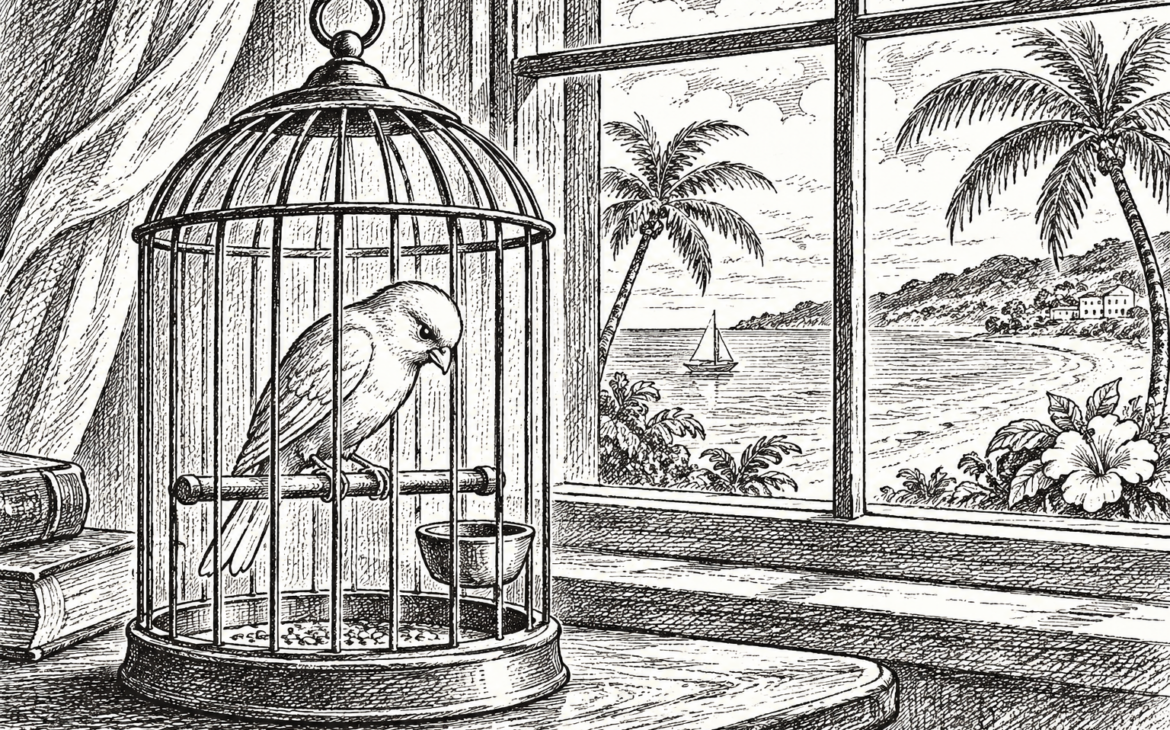
At first glance, this poem seems simple and melancholy, yet strangely perplexing. According to Pattee, it was first published in the Freeman’s Journal, July 3, 1782, under the title “On a Lady’s Singing Bird, a native of the Canary Islands, confined in a very small cage. Written in Bermuda, 1778.” Freneau evidently thought the poem worthy of republishing, which he did in 1786, and again with significant revisions in 1809.
Freneau was known for his affection for animals, and the poem certainly reflects his deep concern with liberty, human cruelty, and mankind’s tyrannical relationship with nature. Yet literary scholars have suggested that it may contain more subtle and personal meanings.
A 1981 PhD Thesis by Frank A. Lovelock, “Philip Freneau’s Wildflower: An Analysis of the ‘Amanda’ Poems,” pp. 75-80, includes a detailed analysis of the poem and its successive revisions. Lovelock observes that “Though the theme seems trivial, the caged bird evokes in places the image of a human slave who berates mankind in general and his young mistress in particular for capturing and imprisoning him.”
Lovelock speculated that Amanda was a woman whom Freneau encountered as early as 1778 in Bermuda. Lewis Leary (That Rascal Freneau, p. 72) noted that Freneau spent time in Bermuda courting a woman named Frances, the daughter of the Loyalist governor, George James Bruere. Lovelock interprets Amanda as a figure through whom Freneau, the romantic, explores unattainable beauty but suffered eventual disappointment.
Thus, the poem may be something more than a lament for a captive bird. Its themes of confinement, longing, and frustrated freedom may also reflect Freneau’s own emotional experience, providing insights into areas of his personality that we know very little about.
— Barry Orr
—————
A native of the Canary Islands, confined in a small cage
Happy in my native grove,
I from spray to spray did rove,
Fond of music, full of love.
Dressed as fine as bird could be,
Every thing that I did see,
Every thing was mirth to me.
There had I been, happy still,
With my mate to coo and bill
In the vale, or on the hill.
But the cruel tyrant, man,
(Tyrant since the world began)
Soon abridged my little span.
How shall I the wrong forget!
Over me he threw a net;
And I am his prisoner yet.
To this rough Bermudian shore
Ocean I was hurried o’er,
Ne’er to see my country more!
To a narrow cage confined,
I, who once so gaily shined,
Sing to please the human kind.
Dear Amanda! —leave me free,
And my notes will sweeter be;
On your breast, or in the tree!
On your arm I would repose —
One —oh make me —of your beaus —
There I would relate my woes.
Now, all love, and full of play,
I so innocently gay,
Pine my little life away.
Thus to grieve and flutter here,
Thus to pine from year to year;
This is usage too severe.
From the chiefs who rule your isle,
I will never court a smile;
All, with them, is prison style.
But from your superior mind
Let me but my freedom find,
And I will be all resigned.
Then your kiss will hold me fast—
If but once by you embraced,
In your ‘kerchief I will rest.
Gentle shepherds of the plain,
Who so fondly hear my strain;
Help me to be free again.
‘Tis a blessing to be free:—
Fair Amanda!—pity me,
Pity him who sings for thee.
But if, cruel, you deny
That your captive bird should fly,
Here detained so wrongfully,
Full of anguish, faint with woe,
I must, with my music, go
To the cypress groves below.
NO COMMENTS