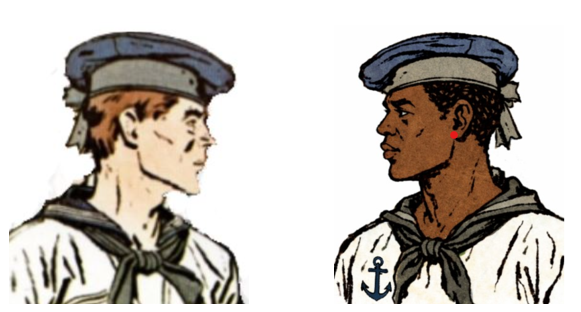
Edwin Arrowsmith and David Schanck
Matawan’s contribution to the Civil War can be traced through the lives of individual residents whose names survive in census schedules, military records and family monuments. I had done a paper involving African American Civil War Veterans in Matawan but had focused only on army veterans. While conducting research on Project 1850 I came across a Black family whose son, David Schanck, would enlist in the Union Navy years later. I sent for his records stored in the National Archives and received information documenting his fascinating service.
In our Wall of Honor, MHS documented a white Union sail, Edwin Arrowsmith, who failed to return to his family after the war. Both Edwin and David enlisted in 1863, and both were involved in the Union’s effort to close Confederate ports and sustain its fleets.
Their lives took very different courses. Edwin died in Confederate captivity. David returned to Matawan, raised a family and lived long enough to apply for a pension that preserved an unusually detailed account of his service. Together, their records allow us to examine how men from the same community contributed to a national struggle, and what that service cost them.
The Arrowsmith household
Edwin was a son of Thomas H. Arrowsmith and Ann Eliza Bedle, members of a family long associated with local trades and business. The 1850 census places Thomas, a forty-seven-year-old wheelwright with real estate valued at $2,000, in Middletown Point in the vicinity of what is now 204-208 Main Street, with Ann Eliza and their children Mary Elizabeth, Edwin, Henry and the infant William. Edwin was recorded as eight years old and attending school. Of interest is the fact that Edwin’s uncle Simon Arrowsmith was the census enumerator.
Thomas’s work later included cabinetmaking and undertaking, occupations that frequently overlapped when a local craftsman made both household furniture and coffins. His undertaking business became a familiar part of Matawan life and continued under his son William E. Arrowsmith. Edwin’s own early working life followed the family’s skilled trades: the 1860 census described him as an eighteen-year-old cabinetmaker’s apprentice.
The Schanck Family
David’s family history is less easily resolved. The 1850 census includes an eight-year-old David in the household of Joseph and Phebe Schanck, together with John Schanck, seventeen. Census records place the residence probably in the waterfront neighborhood behind the present 74–80 Main Street properties, near the old Episcopal church, now the A Salut restaurant. David was not listed as having attended school the previous year.
In sworn pension testimony in 1910, David identified his parents as Elias and Eleanor Schanck, different from the adult Schancks he was enumerated with in 1850. He described himself as the oldest of eleven children and named a living brother, Theodore, in Jersey City. He also stated that, except for his naval service, he had lived throughout his life in Matawan, formerly Middletown Point.
After the war David farmed and made his home in the Matawan area with wife Sarah. They repeatedly reported a marriage date of June 23, 1872. In a 1915 pension questionnaire he listed eight children, of whom three were then living. The surviving records describe a family that experienced considerable loss over the years. David died on June 14, 1917; Sarah followed on April 19, 1918.
Edwin Arrowsmith aboard New Ironsides
Edwin entered the Navy at New York in June 1863. His naval record identifies his rating as coal heaver, an essential position aboard a steam warship. Coal had to be moved and supplied to the machinery spaces that powered the vessel. The work was physically demanding, and the ship’s ability to maneuver depended on the labor of men whose names rarely appear in accounts of naval engagements. His initial enlistment record identified a trade of “blacksmith”.
Records place Edwin with the South Atlantic Squadron in July 1863 and records “N. Iron.” Subsequent muster rolls examined for December 1863 and April 1864 also place him aboard USS New Ironsides.
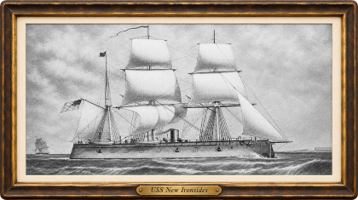 The USS New Ironsides was one of the most powerful American warships of the Civil War. A steam-powered broadside ironclad, she carried a principal battery of fourteen 11-inch Dahlgren smoothbore guns and two 150-pounder Parrott rifles, supplemented by lighter weapons. The 11-inch measurement described the diameter of the Dahlgren’s bore; the Parrott designation referred to the weight of its projectile. These were heavy naval weapons capable of delivering a destructive bombardment against shore defenses and enemy vessels.
Her strength lay in combining that battery with substantial protection. Iron plates 4½ inches thick shielded the sides of her battery, backed by heavy timber. Armored bulkheads protected its ends, forming a defensive enclosure around the gun deck. Unlike an unarmored wooden warship, she could sustain repeated enemy hits while continuing to fight. Her broadside arrangement brought several heavy guns to bear on a target at once, making her particularly valuable for sustained bombardment.
She had joined the South Atlantic Blockading Squadron in January 1863. In the Charleston operations her firepower supported the blockade and the campaign against the harbor defenses. During Edwin’s documented time aboard, she remained part of the force maintaining pressure on Charleston. The Navy’s ship history records that she left the area for Philadelphia in May 1864 and was decommissioned on June 30. The New Ironsides had already participated in important fighting before the November 1863 entry identifying Edwin aboard her.
The next part of Edwin’s story remains incomplete. His name does not appear on the October 1864 New Ironsides roll examined in this research. The ship’s log may have a notation reflecting how and why Edwin left the ship, but a visit to the National Archives in Washington would be needed to ascertain this – these records aren’t available online, and the Archives advised me I’d have to search them myself.
Reading the various histories of the different joint naval/army actions on the Atlantic coast during the fall of 1864 determined that naval personnel – both Marines and sailors – would often be detached from ships in the blockading squadron to support land forces. This is what I believe happened to Edwin.
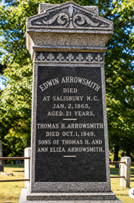 A Confederate prisoner record describing his occupation or capacity as “wagon master” has raised the possibility of subsequent work with Army transportation, which would make sense based on his “blacksmith” designation in his initial enlistment record. His death at Salisbury, North Carolina, is remembered on the Arrowsmith family monument at Rose Hill Cemetery. The cemetery transcription records January 2, 1865, and an age of twenty-one. I spoke with historians familiar with the Salisbury Prison Camp, who advised me that prisoners were buried in mass graves, and the Rose Hill monument is most likely a memorial stone.
Salisbury was a Confederate prison whose conditions deteriorated severely as its population increased in the latter part of 1864. Overcrowding, inadequate supplies and disease produced widespread suffering and death. These conditions provide the setting for Edwin’s final month. The prison camp death record shows no cause of death, but three prisoners before his listing indicate “shot by guard”.
Thomas and Ann Eliza lived for many years after their son’s death. Their family business continued, and Edwin’s siblings carried the Arrowsmith name into the later history of the town. Edwin’s own life ended before he could share in that future.
David Schanck serving as “David Ryan”
David entered the Navy under the name “David Ryan”. The alias is central to finding his military records and understanding his pension application- it doesn’t identify a second man. The pension investigation eventually connected the Matawan resident with the sailor through testimony that included recognition by a former shipmate. The reason David used Ryan has not been established, although the fellow shipmate, who also used an assumed name, stated that he did so because his father didn’t want him to enlist.
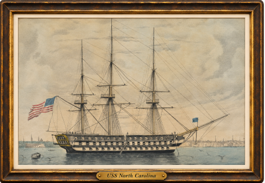 A Treasury Department service statement dated February 15, 1894, provides the clearest outline of his naval career. It records an enlistment as a “landsman” aboard the USS North Carolina on August 27, 1863, followed by service associated with the USS Vermont, USS Memphis and USS Supply. After his first discharge in September 1864, he reenlisted as an ordinary seaman and subsequently served aboard the USS Fort Morgan until August 22, 1865.
David’s initial rating, landsman, was used for a recruit without the experience expected of a trained seaman. The service statement carries him on the USS North Carolina through September 30, 1863, then on the USS Vermont through October 23.
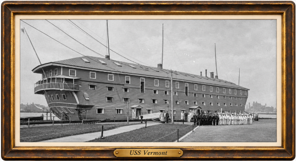 The Vermont served at Port Royal, South Carolina, as a receiving, hospital, ordnance and store ship supporting the South Atlantic Blockading Squadron. Her work helped maintain the fleet operating along the Confederate coast. A receiving ship accommodated men entering the service or awaiting assignment, while a store ship held supplies needed by other vessels. David’s early naval experience thus included the support establishment behind the blockade.
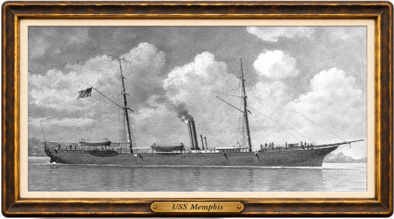 The Treasury statement next places him aboard the USS Memphis through November 27, 1863. The Memphis was a steamship that had itself been captured while running the Charleston blockade in 1862. Purchased and commissioned by the United States Navy, she then served the South Atlantic Blockading Squadron.
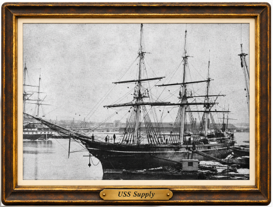
His first enlistment ended with discharge from the USS Supply on September 20, 1864. The Supply carried stores to the blockading squadrons along the Atlantic coast and in the Gulf of Mexico. Her work helped warships remain at their stations instead of repeatedly leaving to replenish their provisions.
David reenlisted within days of that discharge. The Treasury statement gives September 24, 1864, aboard the USS Vermont, now at New York, and carries him there through October 11. Other pension papers give September 29 as the reenlistment date. The important point is consistent: he entered a second period of service rather than returning permanently to civilian life. His rating was now ordinary seaman, a step above landsman.
 His principal vessel during this second enlistment was the USS Fort Morgan, a screw steamer originally commissioned as the Admiral and renamed in September 1864. She carried provisions, ammunition, passengers and general stores between northern ports and the Gulf stations extending from Key West to Galveston. Although a supply vessel, she was armed. Her official history records the capture of two small schooners in November 1864, during the period associated with David’s service.
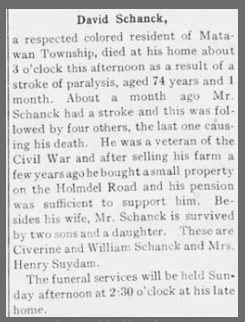 David supplied his own description of this work when examined in June 1896. He recalled joining the Fort Morgan at New York and making repeated voyages between New York and vessels of the Gulf squadron. His memory of some earlier ships and transfers was uncertain, but his account of Fort Morgan as a supply ship agreed with the vessel’s established function.
This was the continuing work that allowed a blockade to operate. Warships needed food and ammunition; crews and passengers had to be moved; stores had to reach ships spread across a long coastline. David’s assignment contributed to that system through the final months of the war and into the period when the Navy was reducing its wartime establishment.
He was discharged from the Fort Morgan on August 22, 1865, the same date the vessel was decommissioned at New York. His recorded naval service had extended for almost two years, with a short interval between enlistments.
Decades later, David had to establish that he was the man who had served as Ryan. In 1897, former shipmate Seth Bennett identified David’s photograph as the sailor he had known aboard Fort Morgan. Bennett also knew that Ryan later lived in Matawan under the name Schanck. The testimony connects the naval record to the local resident in a way that matching names alone could not.
The pension file preserves the difficulties of David’s later years as well. Medical evidence described rheumatism, heart trouble, impaired hearing and an increasing inability to perform manual labor. His final recorded pension was $27 a month. After his death, Sarah received a widow’s pension recorded at $25 a month.
Two men serving a common cause
Edwin and David came from the same community, but they entered a country and a military service that did not offer them equal opportunities. Black sailors served in the Union Navy in substantial numbers, generally in mixed crews, while still encountering racial prejudice and restrictions on advancement. National Archives historian Joseph P. Reidy estimated that approximately 18,000 Black men, roughly one-fifth of the Navy’s enlisted force, served during the war. David belonged to that larger history.
There is no evidence here that Edwin and David were friends, served aboard the same ship or even met during their naval service. Nor do we have letters explaining what each man hoped to accomplish by enlisting. Their common cause is demonstrated by their service: both supported the United States in its war against the Confederacy, a struggle that preserved the Union and brought slavery to an end.
Edwin helped operate an armored warship off Charleston. David served among the vessels and supply arrangements that kept Union squadrons at sea. Their assignments remind us that naval warfare depended on many kinds of work, including labor far removed from the officers and engagements most often remembered.
One man never returned to Matawan. The other returned to farming and family life, and later had to prove the service he had performed under another name. Their records deserve to be read with equal care. Together, Edwin Arrowsmith and David Schanck give us a fuller account of our community’s participation in the Civil War and of the people who carried its burdens.
— Mark Chidichimo
NO COMMENTS