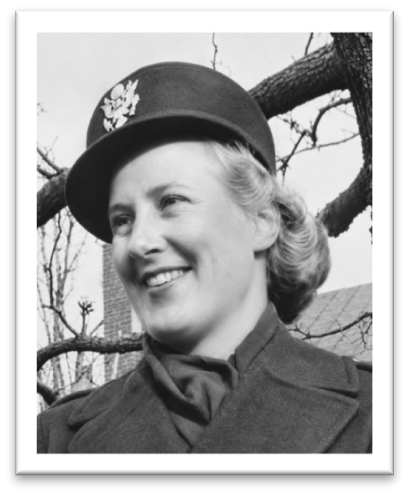
Among the many men and women from Matawan who served their country during World War II was a young nurse whose wartime assignment placed her at the forefront of a remarkable development in medical history. Lieutenant Shirley June Van Brakle, later Shirley Bentley, served in the United States Army Nurse Corps in England, where she worked alongside a surgeon whose pioneering treatment of wounded soldiers helped establish the foundations of modern cardiac surgery.
Shirley was the daughter of James Mathias Van Brakle and Marjorie Hulsart Van Brakle, whose recollections of growing up in Matawan Township at the turn of the twentieth century were featured in last month’s newsletter.
Shirley was born in Matawan on June 7, 1918, the daughter of James and Marjorie Van Brakle. Her father was employed in the brokerage business in New York City and served on the Matawan Borough Council during the early 1930s. Her mother, a descendant of several longstanding local families, left the detailed account of life in Matawan featured on our website that provides a particularly personal glimpse of Shirley’s upbringing. The family built and were the first occupants of 2 Schenck Avenue in 1924, which is currently the residence of MHS members Tibor and Mary-Jo Egervary.
In those recollections, Marjorie described her daughter’s happy childhood, high school education, and employment at Newberry’s before she decided to pursue nursing.
Shirley entered the Monmouth Memorial Hospital School of Nursing in Long Branch, graduating in 1942. Her mother recalled that she received recognition for her bedside nursing and operating-room abilities. Following graduation, Shirley undertook postgraduate training in operating-room techniques at Johns Hopkins. This specialized education would prove particularly valuable during the war.
 On August 2, 1943, Shirley enlisted in the United States Army Nurse Corps. She received her initial military training at Halloran General Hospital on Staten Island, followed by assignments at Fort Monmouth and the Thomas M. England General Hospital in Atlantic City. In April 1944, she traveled to England with the 160th General Hospital.
The timing was significant. Allied forces were preparing for the invasion of Normandy, and American military hospitals in Britain were organizing to receive and treat the enormous number of casualties anticipated from the campaign to liberate Western Europe.
Shirley’s assignment placed her in a medical system that would confront severe injuries on an unprecedented scale. Among the most difficult were penetrating wounds of the chest, heart, and major blood vessels.
Shirley’s obituary identifies her as the operating-room nurse and chief assistant to Dr. Dwight Harken, a pioneering American thoracic surgeon. Harken served as an Army Medical Corps officer in the European Theater. In 1944, he established a specialized chest surgery center at the 160th General Hospital in Cirencester, Gloucestershire, England.
There, Harken and his surgical team developed techniques for removing bullets and shell fragments lodged within or near the hearts and major blood vessels of wounded servicemen.
At the time, operating directly on the heart was extraordinarily dangerous. Surgeons had limited means of controlling bleeding, and the heart-lung bypass machines that would eventually transform cardiac surgery were not yet available. Nevertheless, Harken’s team achieved remarkable results.
According to the official history of the Army Medical Department, the thoracic surgery center performed 134 operations involving retained missiles in or around the heart and great vessels over approximately ten months, without a death among the patients in that series. The work represented an important advance in the treatment of cardiac injuries and helped demonstrate that operations involving the heart could be performed successfully.
Shirley’s documented role as an operating-room nurse and assistant to Harken places her within this pioneering medical effort. Her participation shows that surgical advances depended not only upon the physicians who developed new techniques but upon the trained nurses and other medical personnel responsible for preparing operating rooms, assisting during procedures, and caring for patients afterward.
Shirley’s service was recognized locally – the Matawan Journal reported her promotion in its March 8, 1945, edition, illustrating the article with her photograph. She remained overseas until at least November 1945 and was discharged from the Army Nurse Corps on February 8, 1946.
Following her return to civilian life, Shirley became engaged to Robert Bentley of Red Bank, himself a World War II veteran who had served in the United States Navy. Their engagement was announced in the Matawan Journal on July 17, 1947, and they married on October 26 of that year. The couple eventually settled in the area and raised two sons, Peter and Robert.
Shirley continued her nursing career, serving for many years as a school nurse in the Matawan school system.
She died on October 29, 2000, at the age of 82. Her obituary appeared in the Asbury Park Press on October 31. She was buried in Old Tennent Churchyard, where her husband was also laid to rest.
Fortunately, Shirley’s wartime experiences have not been entirely lost. Historian Helen Henderson included photographs and accounts of her service in two books documenting the history of Matawan and Aberdeen.
A more unusual chapter in the preservation of her story emerged in 2019, when Elizabeth McDermott, a volunteer in the Red Bank Public Library’s Local History Room, discovered a scrapbook at an estate sale. The scrapbook contained material associated with Shirley’s wartime service in England, including medical notes, drawings, photographs, and personal mementos.
McDermott’s research led her to the Betty H. Carter Women Veterans Historical Project at the University of North Carolina at Greensboro, where another collection of Shirley’s photographs and papers had been preserved. The university’s collection provides an important documentary record of Shirley’s military career and offers opportunities for further research into her experiences overseas.
Shirley Van Brakle Bentley’s story is one of many that deserve greater recognition in accounts of Matawan’s military history. Women served during World War II in numerous capacities, including nursing, administration, communications, transportation, and other essential military functions. Their contributions were indispensable to the war effort, even though their experiences have often received less attention than those of male servicemen. Shirley’s career illustrates the importance of examining those contributions individually.
She was not simply a local woman who joined the Army during wartime. She was a professionally trained nurse whose specialized skills placed her in an operating room where physicians and nurses were confronting some of the most challenging injuries of the war and helping to establish new possibilities for cardiac surgery. Her service offers a particularly meaningful starting point for a broader examination of the women of Matawan and Aberdeen who served in the armed forces during World War II. Their stories, like Shirley’s, are part of our community’s history and deserve to be documented and remembered.
— Mark Chidichimo
NO COMMENTS