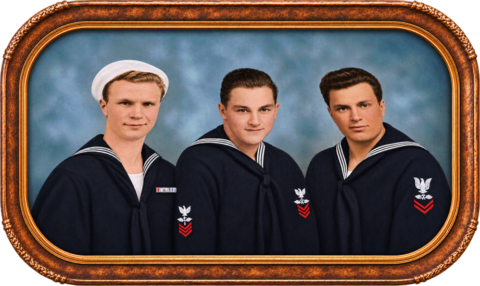
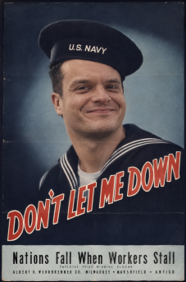
 When I saw the poster to the right, I remembered speaking with MHS treasurer John Lazar about his grandfather John and great uncles Joseph and Bill (l to r. Joseph, John and Bill in the image, above). The portrait of the three is simply wonderful and reminded me of how that generation was affected by World War II. John and my daughter Nina are contemporaries – my dad was of his grandfather’s age. Their story is like that of so many young men who were born in the 1920s whose future was interrupted by war.
Joseph Andrew Lazar (1918-2008) joined the Navy on May 8, 1939. After bootcamp, he was assigned to the USS Leary (DD-158), a Wilkes Class destroyer of the WWI era laid down in 1918, the year he was born. Serving as a fireman in the ship’s engine room, for one reason or another he decided he’d prefer the air arm of the Navy and transferred to the Naval Aviation Technical Training Center in Chicago in October of 1943. That was a fortuitous choice. Two months later the Leary was escorting a convoy in the North Atlantic and during a storm made sonar contact with a German U Boat off her starboard bow. Before she could react, a torpedo struck her after engine room and exploded, ultimately sinking the ship and killing 98 men aboard. Joseph most likely wouldn’t have survived the attack, and he most certainly lost many close friends and shipmates. He finished the war as an Aviation Machinist’s Mate 1st Class at the Naval Air Station in the Canal Zone with Patrol Bombing Squadron 205.
William “Bill” Lazar (1920-1966) enlisted in the Navy on February 21, 1942. He apparently spent his career at the Aviation Technical Training Center in Chicago and attained the rank of Aviation Metalsmith 2nd class at the time of his discharge.
John’s grandfather John Lazar (1924-1999) enlisted in the Navy on July 17,1943 at 18 years of age and received basic training at Newport, RI. He was an aviation metalsmith like his brother Bill, achieving the eventual rank of AM1. He served the aircraft of the various patrol and training squadrons of NAS Corpus Christi, TX, during the war.
Men and women of that generation were eager to serve. In Ken Burn’s documentary The War, Burns spoke of some who received a medical waiver – classified “4F” – and being so ashamed committed suicide.
My uncle served with the New Mexico National Guard – the entire unit was captured in the Philippines in 1942, and he spent the rest of the war in a Japanese POW camp in China. My father Frank Chidichimo (1928-2022) watched his neighbors and cousins go off to fight and begged my grandmother to sign a waiver so he could join the Marines. He turned 17 in October of 1945 – the war was over and she relented. (If Truman hadn’t authorized the use of the Atomic Bomb, my dad most likely would have participated in the invasion of Japan. There were estimates that American forces would have suffered a million killed and wounded in this event.)
I grew up in the 50s and 60s when US military culture flooded the movies, television and comic books (GI Combat was my favorite). We all had toy guns, and I used my dad’s Marine gear to “play army.” I can’t imagine this occurring today.
When researching Arris Banke, I learned he was lost in the Gulf of Mexico on his last training flight in 1943. I could relate to that – in November of 1971, I was a passenger in a Navy S2 Tracker over the Gulf of Mexico when an electrical short caused an explosion inside the aircraft – at night, and in the middle of a storm. The crew chief told me and another midshipman that we most likely were going to ditch and instructed us how to exit the aircraft and inflate our life vests. Fortunately, the pilot nursed the plane into NAS Corpus Christi (where John Lazar’s grandfather had served) and we landed safely. This event impressed (no, scarred me) and really made me appreciate our serviceman, especially aviators.
In 2019, I was selected to be the Team Genealogist for Project Recover (https://www.projectrecover.org/) – they recover MIA remains and I locate the families for their repatriation. We returned the remains of a sailor to a family in Nutley in 2023 – it was one of the most moving experiences I ever had.
MHS celebrates our veterans – both living and deceased. Looking at that wonderful portrait of Joseph, John, and Bill Lazar, I see more than three young men in uniform – I see an entire generation whose lives were forever shaped by a war they did not choose, but whose burdens they willingly shouldered.
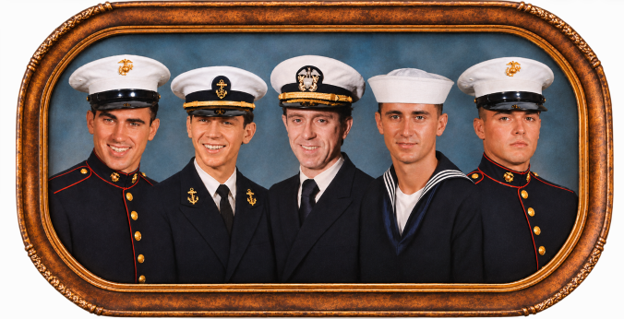
Inspired by John’s family portrait: My dad as a Marine in the 40s, me as a midshipman in 1970, brother Bill as a newly commissioned officer in 1975, brother Matt as an Aviation Ordnanceman in the late 80s, and son Chris as a Marine in 1992. I feel a bit embarrassed to put my pic with this lot, since I only had five weeks of active duty in 71. But my five years in NCIS – with an entire year spent aboard a carrier – gives me an excuse to associate with these TRUE veterans.
— Mark Chidichimo
NO COMMENTS