Imagine this: it was a sultry morning in early July 1900. Several old-timers were sitting on the porch of the Old Homestead Hotel on Main Street, across from what is now Memorial Park at Broad and Main. Among them was Beekman Nowland (born 1831), who had been a blacksmith in Middletown Point in 1850 and was still active in the trade. Sharing a cold brew with him were Charles Thomas Fardon (born 1824), a former wheelwright, William Schenck Conover (born 1830), a former stage driver who was now employed as a hostler in Shrewsbury Township and Edwin Clarence Disbrow (born 1833), another former stage driver who had become a harness maker.
Perhaps they reminisced about old acquaintances: longtime blacksmith David Conine, then living in Michigan, and stage operator Nicholas Morgan Disbrow, who had died in 1864. Nicholas was gone, but his great-grandson, Levi S. Emmons (1878–1954), was still living in Matawan and working as a blacksmith.
Matawan had been a center for horse-drawn transportation for decades. (See Suzy Del Mage’s article on the carriage factory in last month’s newsletter.) In 1900 the horse economy was still very much alive. William Van Brunt operated his livery stable and stage line, while Samuel Towler’s livery stable provided transportation for a “water wagon” that helped keep dust down on local streets. If you wanted to travel any appreciable distance, you generally needed a horse. And horses supported an entire economic network: breeders, farmers who grew hay and grain, feed merchants, veterinarians, blacksmiths, harness makers, wheelwrights, stablemen and others. People’s livelihoods depended upon them.
As our group sat on the hotel porch, let’s say they heard an unfamiliar sound approaching along Main Street: an automobile driven by Yonkers dentist Charles R. Burlew (1872–1955), who was in the area visiting relatives. A motorcar would have given them plenty to talk about. Automobiles were noisy and could frighten horses. People worried about pedestrian safety, speed and the dust the machines kicked up on unpaved roads. But for men whose lives had been connected to horses, there may have been a more personal question: What would this new technology mean for them and for the people whose livelihoods depended upon a transportation system that had existed for centuries?
Every generation lives through technological change.
My grandfather was born in 1901, only two years before the Wright brothers’ first flight. I remember sitting with him in 1969 as Neil Armstrong stepped onto the moon and watching his reaction. In one lifetime he had gone from the infancy of powered flight to a man walking on another world.
My own experience with information technology has been less dramatic, but the progression is remarkable when I think about it. As a child in the 1950s, if I needed a book I walked to the local library. In the 1960s, a local grocery store offered an inexpensive volume of an encyclopedia with every $10 purchase. My siblings and I waited eagerly for each new installment. I used encyclopedias throughout high school for research papers. They were useful, but they contained compressed information selected and approved by editors, and there was only so much that could fit between the covers.
College gave me access to a well-stocked university library and vastly expanded the information available to me. I still wrote assignments by hand and then found someone I could pay a couple of bucks to type them. When I bought my first commercially available word processor from Sears in 1986, I almost wept when I discovered how easily I could edit text, move entire passages around and print on a dot matrix printer with the touch of a button.
Later, during my government career, MHS member Pat Noble and I acquired full-text search and retrieval software in the 1990s to help manage the huge volume of information we had to process. We were the first in our organization to use that technology, and it was a game changer. Then came the Internet and search engines, which could scour enormous repositories of information, followed by sites such as Wikipedia that attempted to gather and summarize information in one place. Pat later built his own “Wiki” network to manage information in our office.
Then came artificial intelligence.
If visiting the local library and using a basic encyclopedia were “walking” on the information highway, and gaining access to a major research library was “flying,” the Internet might be compared to a rocket ship. I look at AI as something different again: perhaps a multidimensional teleporter. It can help us aggregate, index, compare, analyze and process enormous amounts of information at a speed that would have been unimaginable not very long ago. Like any powerful new technology, however, learning how to use it well takes time and judgment.
There are people reading this who are far more adept at using AI than I am, and what follows represents only my own experience. I use it primarily as a research and editorial assistant — a force multiplier, not a substitute for judgment.
My background in intelligence analysis shapes the way I approach it. A good analyst needs several things: deep institutional knowledge of the subject matter; refined critical-thinking skills that allow the effective use of inductive and deductive reasoning; and the ability to recognize and separate personal beliefs and biases from the evidence being examined. In my experience, the better the researcher is at those things, the more useful AI becomes.
The way a question is asked matters. If I tell an AI agent, “Give me information that supports this argument,” I should not be surprised when it does exactly that. For objective research, though, I try to begin with neutral questions: “What information is available on this subject?” “What evidence supports or contradicts this conclusion?” “What am I missing?” I can then deliberately test competing explanations rather than merely asking the AI agent to confirm what I already believe.
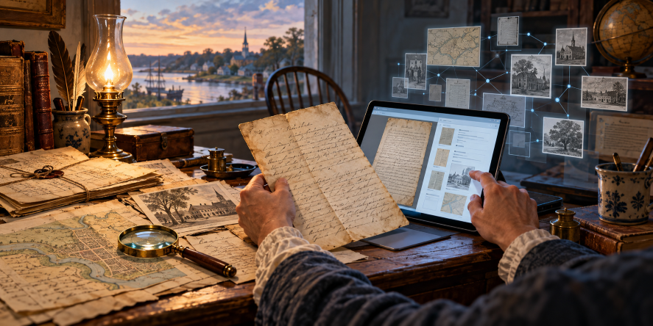
AI also cannot analyze records it cannot access. It can search sources available to it on the Internet and can work with documents I upload or otherwise make available, but that does not mean it has searched everything that exists. Some of the most valuable historical information is still buried in handwritten minutes, old newsletters, vertical files, photographs and other material that has never been digitized. I have tested AI by asking it to locate text I already know exists in obscure sources. Sometimes it finds it immediately; sometimes the exercise shows me where the limits are. In those cases, the answer may be to digitize another box of records and add them to the searchable collection.
And it can be wrong.
Generative AI systems can produce answers that sound entirely plausible but are unsupported or simply false. This is commonly called “hallucination.” The problem has received considerable attention after attorneys submitted court filings containing nonexistent cases and citations produced by AI. The lesson is not that AI cannot be used for serious work. The lesson is that the person using it remains responsible for checking the work. If a statement matters, I want to know where it came from. If a citation is provided, I want to open the source and make sure it says what the AI claims it says.
That is not very different from the standard I would apply to a human researcher.
Another understandable concern is that AI will take people’s jobs. I cannot predict how all of that will play out. I do know how I would have used it in my previous work experiences, though.
In 2017, I conducted a massive wire-fraud investigation. Millions of dollars in suspicious wire transfers were being sent through a wide variety of shell companies before eventually reaching several entities in Central America. I spent roughly two solid months identifying transfers, examining patterns and manually charting them on spreadsheets before I could see clearly what was happening. With today’s analytical tools, much of that pattern recognition could potentially have been accomplished dramatically faster. The important point is what I could have done with the time saved: apply the same investigative attention to dozens of smaller cases that we simply did not have the manpower to address.
That is why I tend to think of AI as a force multiplier. It does not eliminate the need for subject-matter knowledge, skepticism, judgment or verification. In many ways, it makes those qualities more important.
I am providing two examples for your review. The first is a paper on African American Civil War Veterans that I prepared much as I would have written a college paper fifty years ago: weeks of research condensed into several pages. I retained the supporting documentation, although for readability I did not burden the article with citations throughout. The second is the paper on education in Matawan embedded in this newsletter. In this case, AI helped compile and organize the underlying information — including some material I might never have found on my own — into a preliminary narrative of bullet points. I then rewrote most and edited it in my own style and checked the citations. I maintained the paragraph heading protocol because I liked the way it separated info and made it more readable, a device I’ll continue to use. The AI-assisted compilation took several hours after refinement taskings; my review, rewriting and verification took a couple of days.
I know which process I prefer.
I do not know what Beekman Nowland and his friends would actually have said if an automobile came rattling down Main Street that hot July morning in 1900. Perhaps one of them would have dismissed it as an expensive toy. Perhaps another would have worried about frightened horses, dangerous speeds or what the infernal contraption might mean for his livelihood. Those concerns would not have been foolish. The automobile really did transform their world.
But the horse did not disappear that afternoon, and neither did the knowledge and skills of the people who understood transportation in 1900. The new technology gradually changed how those skills were used and which ones would remain valuable. Both William Van Brunt and Samuel Towler gradually substituted gasoline powered vehicles for horses and successfully expanded their business concerns accordingly.
I look at artificial intelligence much the same way. It is a tool — an extraordinarily powerful one — but a tool nonetheless. What we get from it still depends to a remarkable degree upon the knowledge, judgment and care of the person sitting behind the wheel.
(Author’s note: the people described above existed, and Dr. Burlew did indeed drive his automobile around Matawan in early July of 1900, causing quite the sensation.)
— Mark Chidichimo
NO COMMENTS